

Knopf Doubleday Publishing Group
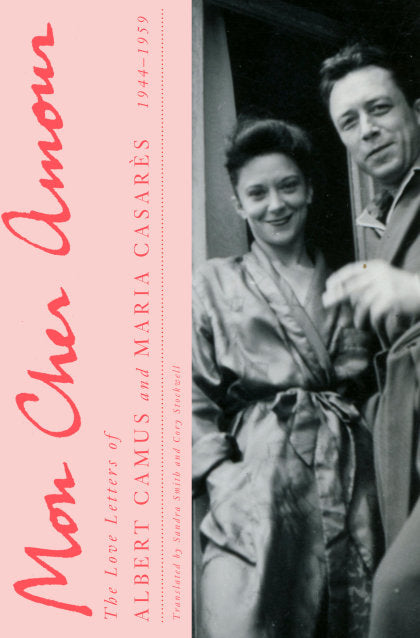
Mon Cher Amour
Mon Cher Amour
Couldn't load pickup availability
Collapsible content
ABOUT
Albert. Albert chéri. Write me sweet, passionate things. Tell me you love me and how you love me. Tell me you’ll take me to the sea one day—any sea at all—and that we’ll spend time on the shore and in the water. Tell me you’ll always be with me. Tell me about you, and especially today, talk to me about us. —Maria Casarès to Albert Camus, February 1, 1950
It’s said that the affair began on June 6, 1944, the day the Allied forces landed in Normandy. The twenty-one-year-old Casarès was starring in a production of the thirty-year-old Camus’s play The Misunderstanding—and one thing (an after-party hosted by Jean-Paul Sartre and Simone de Beauvoir) led to another.
Though their fling would be cut short by the end of the Occupation—and the return to Paris of Camus’s wife, Francine—the two were destined to meet again: four years later, to the day, they crossed paths by chance on the Boulevard Saint-Germain.
Over the next twelve years, without interruption—until the car wreck of January 4, 1960, that stole Camus’s life—the author and actress would correspond furiously, their words swelling and shimmering and surging like the ocean.
Ah! It’s so hard to leave you, your dear face will again fade into the night, but I’ll find you once more in this ocean you love, at the time of evening when the sky takes on the color of your eyes. —Albert Camus to Maria Casarès, June 1, 1949
Across 865 letters of immense and exquisite emotion, they cry and laugh and bicker and beg, make and break promises, talk Stendhal and Proust and Orwell, French theater, sickness, death, writer’s block, and, most of all, they pine—leaving behind a record of one of the great love stories of the twentieth century.
STANDARD, PRIMARY, DM AND VARIANT COVERS
Standard and Primary covers are widely available through general retailers. They often have higher print runs and can be cheaper, especially during sales.
In contrast, Direct Market (DM) and variant covers are primarily sold in comic shops. DM editions tend to have more limited availability and may be more valuable to collectors.
The main differences lie in artwork style, availability, price, and collector appeal. Ultimately, the choice between standard and variant covers depends on personal preference, budget, and individual collecting goals.
PRODUCT TYPES
Comic book enthusiasts have various formats to choose from when collecting their favorite stories.
Here's a brief overview of the main types:
Omnibus
- Large, hardcover collections
- Usually contain complete runs or extensive story arcs
- Typically 800-1000+ pages
- Higher price point, often €100-€150
Oversized Hardcover (OHC)
- Similar dimensions to omnibus, but thinner
- Collect shorter runs or story arcs
- Usually 300-600 pages
- Priced between €30-€50
Hardcover (HC)
- Standard-sized hardcover books
- Collect 6-12 issues typically
- Similar dimensions to single issues, but with a hard cover
- Priced around €25-€35
Trade Paperback (TP)
- Softcover collections
- Standard comic book size
- Usually collect 4-6 issues
- Most affordable option, typically €15-€25
Other Formats
- Absolute Editions: Oversized, deluxe hardcovers (mainly DC Comics)
- Compendiums: Massive paperback collections
- Graphic Novels (OGN/GN): Original stories not previously released as single issues
The choice between these formats often depends on personal preference, budget, and collecting goals. Omnibus and OHC editions offer larger artwork and more content but at a higher price, while TPs provide a more affordable way to collect complete story arcs