

Doubleday Canada
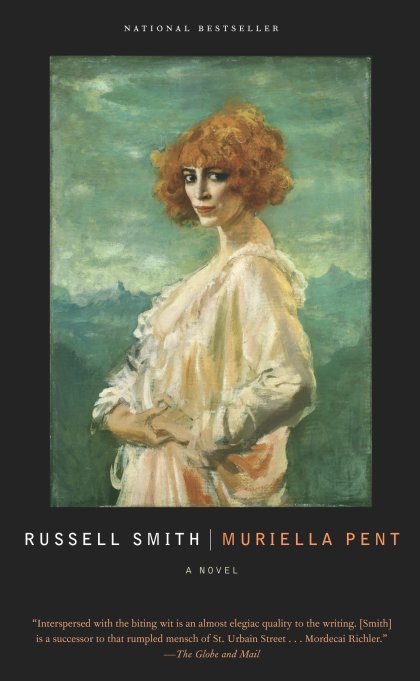
Muriella Pent
Muriella Pent
Couldn't load pickup availability
Collapsible content
ABOUT
The book begins with a poem by Marcus Royston (from his "Island Eclogues") and a fundraising message from Muriella Pent; then, in the first scene, still before chapter one, these two very different writers have a revealing post-coital conversation. The combination of texts and action, the pointed and moving dialogue, and the ineradicable presence of sex tell us a lot about how Muriella Pent will go on: it’s precise and original even before really beginning.
In the first two chapters the principal characters are introduced more fully. Marcus Royston, a successful poet twenty years ago, is now jaded, boozy, and slightly seedy, and finding himself increasingly superannuated on the Caribbean island of St. Andrew’s. Muriella Pent, in the Arts and Crafts oasis of Stilwoode Park in Toronto, is widowed, free, sometimes unhappy, and perhaps a little uncontrolled. Phone conversations introduce us to her younger friend Julia Sternberg and to Brian Sillwell, a student who volunteers alongside Muriella on the very PC City Arts Board Action Council (Literature Committee).
At this committee’s invitation, with a little quiet help from Canada’s ministry of External Affairs, Marcus comes to Toronto on a literary residency, to live in a basement apartment in Muriella’s large house. From his arrival he is a disruptive presence: he instantly flirts with his hostess (and most everyone else), drinks too much, and is constitutionally unable to use the buzzword-heavy language of victimhood, appropriation, and community spoken in the Toronto arts world. As he tells the shocked literature committee, alternative journalists, a meeting of librarians and Muriella’s genteel book club alike: identity politics isn’t everything, art isn’t activism, and a novel shouldn’t be read to uncover the author’s social "message."
"It is not about providing positive influence, or solving the problems of poverty. It’s about the things, all dark things that…" He drained his cup. "All the dark things that motivate us." He stared straight in the eyes of the beautiful young girl and said, "Sex. It’s about sex. Largely. And corruption and decadence. And all the terrible, terrible things we think."
Muriella, Brian, and Julia — that "beautiful young girl" — are unsettled, and inspired.
Perhaps the disastrous and chaotic party held in his honour at Muriella’s house best illustrates the disruptive effect Marcus has on the lives around him, when the explosive power of desire crosses boundaries of age, gender and race. But Marcus is not simply a maverick: he is honest, pained, doubly in exile from a home he is ambivalent about, in sight of old age, and genuinely moved by his connection to Muriella and Julia.
The novel’s collage of diary entries, e-mails, letters and newspaper articles gives us unusual insight into the characters’ needs and weaknesses as they are profoundly affected by crashing into each other. With Marcus and Muriella’s involvement, Brian and Julia develop from wary adolescents into people capable of meaningful action; it is Muriella herself, however, who seems to change the most.
But Muriella Pent works on a wider canvas; for all its psychological acuity it is profoundly, perhaps even primarily, a novel of place. Toronto is a vivid presence, from the roti shops on St. Clair West to historic sites like Fort York, from its earnest, grasping artists to the cosseted, pseudonymous enclave of Stilwoode Park.
As satire and social observation, as an exploration of what art should be and do, as a study of sex as a prime mover in the messy triumphs of our lives, Muriella Pent is unmatched.
STANDARD, PRIMARY, DM AND VARIANT COVERS
Standard and Primary covers are widely available through general retailers. They often have higher print runs and can be cheaper, especially during sales.
In contrast, Direct Market (DM) and variant covers are primarily sold in comic shops. DM editions tend to have more limited availability and may be more valuable to collectors.
The main differences lie in artwork style, availability, price, and collector appeal. Ultimately, the choice between standard and variant covers depends on personal preference, budget, and individual collecting goals.
PRODUCT TYPES
Comic book enthusiasts have various formats to choose from when collecting their favorite stories.
Here's a brief overview of the main types:
Omnibus
- Large, hardcover collections
- Usually contain complete runs or extensive story arcs
- Typically 800-1000+ pages
- Higher price point, often €100-€150
Oversized Hardcover (OHC)
- Similar dimensions to omnibus, but thinner
- Collect shorter runs or story arcs
- Usually 300-600 pages
- Priced between €30-€50
Hardcover (HC)
- Standard-sized hardcover books
- Collect 6-12 issues typically
- Similar dimensions to single issues, but with a hard cover
- Priced around €25-€35
Trade Paperback (TP)
- Softcover collections
- Standard comic book size
- Usually collect 4-6 issues
- Most affordable option, typically €15-€25
Other Formats
- Absolute Editions: Oversized, deluxe hardcovers (mainly DC Comics)
- Compendiums: Massive paperback collections
- Graphic Novels (OGN/GN): Original stories not previously released as single issues
The choice between these formats often depends on personal preference, budget, and collecting goals. Omnibus and OHC editions offer larger artwork and more content but at a higher price, while TPs provide a more affordable way to collect complete story arcs