

Knopf Doubleday Publishing Group
My Old Kentucky Home
My Old Kentucky Home
Couldn't load pickup availability
Collapsible content
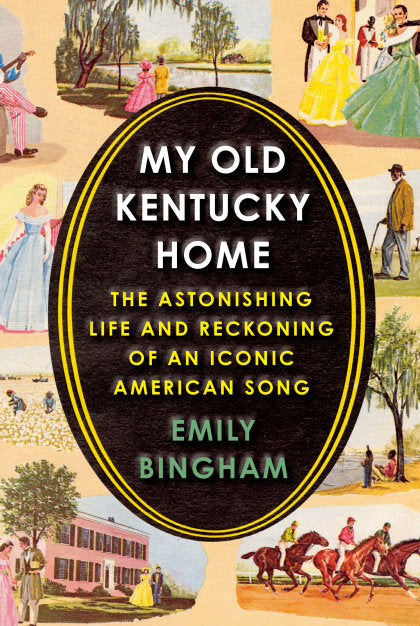
ABOUT
MY OLD KENTUCKY HOME, from its enormous success in the early 1850s, written by a white man, considered the father of American music, about a Black man being sold downriver, performed for decades by white men in blackface, and the song, an anthem of longing and pain, turned upside down and, over time, becoming a celebration of happy plantation life.
It is the state song of Kentucky, a song that has inhabited hearts and memories, and in perpetual reprise, stands outside time; sung each May, before every Kentucky Derby, since 1930.
Written by Stephen Foster nine years before the Civil War, “My Old Kentucky Home” made its way through the wartime years to its decades-long run as a national minstrel sensation for which it was written; from its reference in the pages of Margaret Mitchell’s Gone with the Wind to being sung on The Simpsons and Mad Men.
Originally called “Poor Uncle Tom, Good-Night!” and inspired by America’s most famous abolitionist novel, it was a lament by an enslaved man, sold by his "master," who must say goodbye to his beloved family and birthplace, with hints of the brutality to come: “The head must bow and the back will have to bend / Wherever the darky may go / A few more days, and the trouble all will end / In the field where the sugar-canes grow . . .”
In My Old Kentucky Home, Emily Bingham explores the long, strange journey of what has come to be seen by some as an American anthem, an integral part of our folklore, culture, customs, foundation, a living symbol of a “happy past.” But “My Old Kentucky Home” was never just a song. It was always a song about slavery with the real Kentucky home inhabited by the enslaved and shot through with violence, despair, and degradation.
Bingham explores the song’s history and permutations from its decades of performances across the continent, entering into the bloodstream of American life, through its twenty-first-century reassessment. It is a song that has been repeated and taught for almost two hundred years, a resonant changing emblem of America's original sin whose blood-drenched shadow hovers and haunts us still.
STANDARD, PRIMARY, DM AND VARIANT COVERS
Standard and Primary covers are widely available through general retailers. They often have higher print runs and can be cheaper, especially during sales.
In contrast, Direct Market (DM) and variant covers are primarily sold in comic shops. DM editions tend to have more limited availability and may be more valuable to collectors.
The main differences lie in artwork style, availability, price, and collector appeal. Ultimately, the choice between standard and variant covers depends on personal preference, budget, and individual collecting goals.
PRODUCT TYPES
Comic book enthusiasts have various formats to choose from when collecting their favorite stories.
Here's a brief overview of the main types:
Omnibus
- Large, hardcover collections
- Usually contain complete runs or extensive story arcs
- Typically 800-1000+ pages
- Higher price point, often €100-€150
Oversized Hardcover (OHC)
- Similar dimensions to omnibus, but thinner
- Collect shorter runs or story arcs
- Usually 300-600 pages
- Priced between €30-€50
Hardcover (HC)
- Standard-sized hardcover books
- Collect 6-12 issues typically
- Similar dimensions to single issues, but with a hard cover
- Priced around €25-€35
Trade Paperback (TP)
- Softcover collections
- Standard comic book size
- Usually collect 4-6 issues
- Most affordable option, typically €15-€25
Other Formats
- Absolute Editions: Oversized, deluxe hardcovers (mainly DC Comics)
- Compendiums: Massive paperback collections
- Graphic Novels (OGN/GN): Original stories not previously released as single issues
The choice between these formats often depends on personal preference, budget, and collecting goals. Omnibus and OHC editions offer larger artwork and more content but at a higher price, while TPs provide a more affordable way to collect complete story arcs