

Library of America
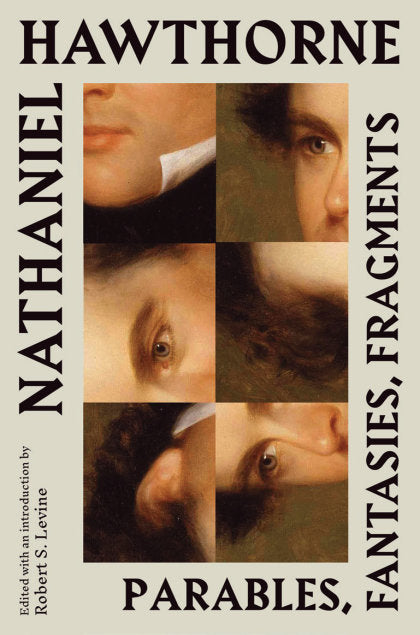
Nathaniel Hawthorne: Parables, Fantasies, Fragments
Nathaniel Hawthorne: Parables, Fantasies, Fragments
Couldn't load pickup availability
Collapsible content
ABOUT
After graduating from college in 1825, Nathaniel Hawthorne returned home to Salem, Massachusetts, where he lived with his mother and sisters for most of the next two decades, honing his craft in his third-story bedroom. During that time, he kept a series of journals, now called the American Notebooks, that became a vital taproot for his stories and novels. They also served as a laboratory where Hawthorne could experiment with fictional ideas and premises, letting his extraordinary imagination play with intriguing, sometimes wild possibilities. Some of his oddest, boldest, and most secretive writing— virtually unknown to readers until now—are the microfictions sprinkled throughout these notebooks, none more than a paragraph long, and many just a single sentence.
Acclaimed Hawthorne scholar Robert S. Levine has selected 200 of these intriguing short works, arranging them into thematic groups covering topics like the writing life, divided selves, and death and imagined afterlives. They reveal Hawthorne as a radical, strikingly modern literary experimenter, their extreme compression and dreamlike strangeness calling to mind Kafka’s parables and aphorisms. Gathered here in a single volume for the first time, they offer thrilling access to what Hawthorne called “the inmost Me behind its veil”—the creative essence of one of America’s greatest storytellers.
STANDARD, PRIMARY, DM AND VARIANT COVERS
Standard and Primary covers are widely available through general retailers. They often have higher print runs and can be cheaper, especially during sales.
In contrast, Direct Market (DM) and variant covers are primarily sold in comic shops. DM editions tend to have more limited availability and may be more valuable to collectors.
The main differences lie in artwork style, availability, price, and collector appeal. Ultimately, the choice between standard and variant covers depends on personal preference, budget, and individual collecting goals.
PRODUCT TYPES
Comic book enthusiasts have various formats to choose from when collecting their favorite stories.
Here's a brief overview of the main types:
Omnibus
- Large, hardcover collections
- Usually contain complete runs or extensive story arcs
- Typically 800-1000+ pages
- Higher price point, often €100-€150
Oversized Hardcover (OHC)
- Similar dimensions to omnibus, but thinner
- Collect shorter runs or story arcs
- Usually 300-600 pages
- Priced between €30-€50
Hardcover (HC)
- Standard-sized hardcover books
- Collect 6-12 issues typically
- Similar dimensions to single issues, but with a hard cover
- Priced around €25-€35
Trade Paperback (TP)
- Softcover collections
- Standard comic book size
- Usually collect 4-6 issues
- Most affordable option, typically €15-€25
Other Formats
- Absolute Editions: Oversized, deluxe hardcovers (mainly DC Comics)
- Compendiums: Massive paperback collections
- Graphic Novels (OGN/GN): Original stories not previously released as single issues
The choice between these formats often depends on personal preference, budget, and collecting goals. Omnibus and OHC editions offer larger artwork and more content but at a higher price, while TPs provide a more affordable way to collect complete story arcs