

Knopf Doubleday Publishing Group
Night Watch
Night Watch
Couldn't load pickup availability
Collapsible content
ABOUT
“Kevin Young is a poet of exceptional depth and sensitivity. . . . Let yourself focus on every phrase.” —Ron Charles, The Washington Post
"Night Watch continues one of the most vital currents in contemporary poetry, transforming history and its silences into lyric through the poet’s eloquent invitation: ‘O wounded soul,/ speak.’” —The New York Times
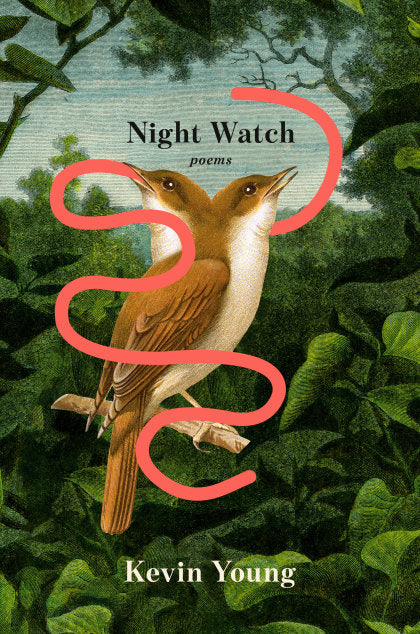
Following on his exquisite Stones, Kevin Young’s new collection, written over the span of sixteen years, shapes stories of loss and legacy, inspired in part by other lives. After starting in the bayous of his family's Louisiana, Young journeys to further states of mind in “All Souls,” evoking “The whale / who finds the shore / & our poor prayers.” Another central sequence, “The Two-Headed Nightingale,” is spoken by Millie-Christine McCoy, the famous conjoined African American “Carolina Twins.” Born into enslavement, stolen, and then displayed by P. T. Barnum and others, the twins later toured the world as free women, their alto and soprano voices harmonizing their own way. Young’s poem explores their evolving philosophical selfhood and pluralities: “As one we sang, /we spake— / She was the body / I the soul / Without one / Perishes the whole.”
In “Darkling,” a cycle of poems inspired by Dante’s Divine Comedy, Young expands and embroiders the circles of Hell, drawing a cosmology of both loneliness and accompaniment, where “the dead don’t know / what to do / with themselves.” Young writes of grief and hope as familiar yet surprising states: “It’s like a language, / loss—,” he writes, “learnt only / by living—there—.” Evoking the history of poetry, from the darkling thrush to the darkling plain, Young is defiant and playful on the way through purgatory to a kind of paradise. When he goes, he warns, “don't dare sing Amazing Grace”—that “National / Anthem of Suffering.” Instead, he suggests, “When I Fly Away, / Don't dare hold no vigil . . . Just burn the whole / Town on down.”
This collection will stand as one of Young’s best—his voice shaping sorrow with music, wisdom, heartache, and wit.
STANDARD, PRIMARY, DM AND VARIANT COVERS
Standard and Primary covers are widely available through general retailers. They often have higher print runs and can be cheaper, especially during sales.
In contrast, Direct Market (DM) and variant covers are primarily sold in comic shops. DM editions tend to have more limited availability and may be more valuable to collectors.
The main differences lie in artwork style, availability, price, and collector appeal. Ultimately, the choice between standard and variant covers depends on personal preference, budget, and individual collecting goals.
PRODUCT TYPES
Comic book enthusiasts have various formats to choose from when collecting their favorite stories.
Here's a brief overview of the main types:
Omnibus
- Large, hardcover collections
- Usually contain complete runs or extensive story arcs
- Typically 800-1000+ pages
- Higher price point, often €100-€150
Oversized Hardcover (OHC)
- Similar dimensions to omnibus, but thinner
- Collect shorter runs or story arcs
- Usually 300-600 pages
- Priced between €30-€50
Hardcover (HC)
- Standard-sized hardcover books
- Collect 6-12 issues typically
- Similar dimensions to single issues, but with a hard cover
- Priced around €25-€35
Trade Paperback (TP)
- Softcover collections
- Standard comic book size
- Usually collect 4-6 issues
- Most affordable option, typically €15-€25
Other Formats
- Absolute Editions: Oversized, deluxe hardcovers (mainly DC Comics)
- Compendiums: Massive paperback collections
- Graphic Novels (OGN/GN): Original stories not previously released as single issues
The choice between these formats often depends on personal preference, budget, and collecting goals. Omnibus and OHC editions offer larger artwork and more content but at a higher price, while TPs provide a more affordable way to collect complete story arcs