

Crown
No-Man's Lands
No-Man's Lands
Couldn't load pickup availability
Collapsible content
ABOUT
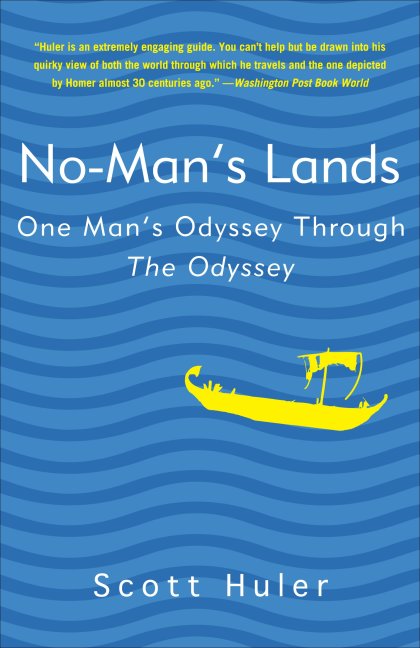
When NPR contributor Scott Huler made one more attempt to get through James Joyce’s Ulysses, he had no idea it would launch an obsession with the book’s inspiration: the ancient Greek epic The Odyssey and the lonely homebound journey of its Everyman hero, Odysseus.
No-Man’s Lands is Huler’s funny and touching exploration of the life lessons embedded within The Odyssey, a legendary tale of wandering and longing that could be read as a veritable guidebook for middle-aged men everywhere. At age forty-four, with his first child on the way, Huler felt an instant bond with Odysseus, who fought for some twenty years against formidable difficulties to return home to his beloved wife and son. In reading The Odyssey, Huler saw the chance to experience a great vicarious adventure as well as the opportunity to assess the man he had become and embrace the imminent arrival of both middle age and parenthood.
But Huler realized that it wasn’t enough to simply read the words on the page—he needed to live Odysseus’s odyssey, to visit the exotic destinations that make Homer’s story so timeless. And so an ambitious pilgrimage was born . . . traveling the entire length of Odysseus’s two-decade journey. In six months.
Huler doggedly retraced Odysseus’s every step, from the ancient ruins of Troy to his ultimate destination in Ithaca. On the way, he discovers the Cyclops’s Sicilian cave, visits the land of the dead in Italy, ponders the lotus from a Tunisian resort, and paddles a rented kayak between Scylla and Charybdis and lives to tell the tale. He writes of how and why the lessons of The Odyssey—the perils of ambition, the emptiness of glory, the value of love and family—continue to resonate so deeply with readers thousands of years later. And as he finally closes in on Odysseus’s final destination, he learns to fully appreciate what Homer has been saying all along: the greatest adventures of all are the ones that bring us home to those we love.
Part travelogue, part memoir, and part critical reading of the greatest adventure epic ever written, No-Man’s Lands is an extraordinary description of two journeys—one ancient, one contemporary—and reveals what The Odyssey can teach us about being better bosses, better teachers, better parents, and better people.
STANDARD, PRIMARY, DM AND VARIANT COVERS
Standard and Primary covers are widely available through general retailers. They often have higher print runs and can be cheaper, especially during sales.
In contrast, Direct Market (DM) and variant covers are primarily sold in comic shops. DM editions tend to have more limited availability and may be more valuable to collectors.
The main differences lie in artwork style, availability, price, and collector appeal. Ultimately, the choice between standard and variant covers depends on personal preference, budget, and individual collecting goals.
PRODUCT TYPES
Comic book enthusiasts have various formats to choose from when collecting their favorite stories.
Here's a brief overview of the main types:
Omnibus
- Large, hardcover collections
- Usually contain complete runs or extensive story arcs
- Typically 800-1000+ pages
- Higher price point, often €100-€150
Oversized Hardcover (OHC)
- Similar dimensions to omnibus, but thinner
- Collect shorter runs or story arcs
- Usually 300-600 pages
- Priced between €30-€50
Hardcover (HC)
- Standard-sized hardcover books
- Collect 6-12 issues typically
- Similar dimensions to single issues, but with a hard cover
- Priced around €25-€35
Trade Paperback (TP)
- Softcover collections
- Standard comic book size
- Usually collect 4-6 issues
- Most affordable option, typically €15-€25
Other Formats
- Absolute Editions: Oversized, deluxe hardcovers (mainly DC Comics)
- Compendiums: Massive paperback collections
- Graphic Novels (OGN/GN): Original stories not previously released as single issues
The choice between these formats often depends on personal preference, budget, and collecting goals. Omnibus and OHC editions offer larger artwork and more content but at a higher price, while TPs provide a more affordable way to collect complete story arcs