

Penguin Publishing Group
Nothing If Not Critical
Nothing If Not Critical
Couldn't load pickup availability
Collapsible content
ABOUT
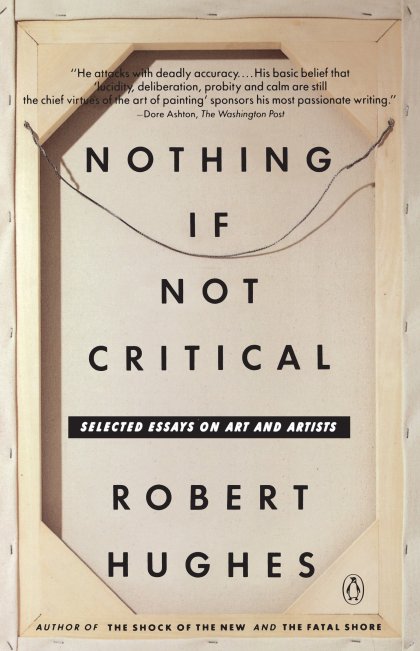
As art critic for Time magazine, internationally acclaimed for his study of modern art, The Shock of the New, he is perhaps America’s most widely read and admired writer on art. In this book: nearly a hundred of his finest essays on the subject.
For the realism of Thomas Eakins to the Soviet satirists Komar and Melamid, from Watteau to Willem de Kooning to Susan Rothenberg, here is Hughes—astute, vivid and uninhibited—on dozens of famous and not-so-famous artists. He observes that Caravaggio was “one of the hinges of art history; there was art before him and art after him, and they were not the same”; he remarks that Julian Schnabel’s “work is to painting what Stallone’s is to acting”; he calls John Constable’s Wivenhoe Park “almost the last word on Eden-as-Property”; he notes how “distorted traces of [Jackson] Pollock lie like genes in art-world careers that, one might have thought, had nothing to do with his.” He knows how Norman Rockwell made a chicken stand still long enough to be painted, and what Degas said about success (some kinds are indistinguishable from panic).
Phrasemaker par excellence, Hughes is at the same time an incisive and profound critic, not only of particular artists, but also of the social context in which art exists and is traded. His fresh perceptions of such figures as Andy Warhol and the French writer Jean Baudrillard are matched in brilliance by his pungent discussions of the art market—its inflated prices and reputations, its damage to the public domain of culture. There is a superb essay on Bernard Berenson, and another on the strange, tangled case of the Mark Rothko estate. And as a finale, Hughes gives us “The SoHoiad,” the mock-epic satire that so amused and annoyed the art world in the mid-1980s.
A meteor of a book that enlightens, startles, stimulates and entertains.
STANDARD, PRIMARY, DM AND VARIANT COVERS
Standard and Primary covers are widely available through general retailers. They often have higher print runs and can be cheaper, especially during sales.
In contrast, Direct Market (DM) and variant covers are primarily sold in comic shops. DM editions tend to have more limited availability and may be more valuable to collectors.
The main differences lie in artwork style, availability, price, and collector appeal. Ultimately, the choice between standard and variant covers depends on personal preference, budget, and individual collecting goals.
PRODUCT TYPES
Comic book enthusiasts have various formats to choose from when collecting their favorite stories.
Here's a brief overview of the main types:
Omnibus
- Large, hardcover collections
- Usually contain complete runs or extensive story arcs
- Typically 800-1000+ pages
- Higher price point, often €100-€150
Oversized Hardcover (OHC)
- Similar dimensions to omnibus, but thinner
- Collect shorter runs or story arcs
- Usually 300-600 pages
- Priced between €30-€50
Hardcover (HC)
- Standard-sized hardcover books
- Collect 6-12 issues typically
- Similar dimensions to single issues, but with a hard cover
- Priced around €25-€35
Trade Paperback (TP)
- Softcover collections
- Standard comic book size
- Usually collect 4-6 issues
- Most affordable option, typically €15-€25
Other Formats
- Absolute Editions: Oversized, deluxe hardcovers (mainly DC Comics)
- Compendiums: Massive paperback collections
- Graphic Novels (OGN/GN): Original stories not previously released as single issues
The choice between these formats often depends on personal preference, budget, and collecting goals. Omnibus and OHC editions offer larger artwork and more content but at a higher price, while TPs provide a more affordable way to collect complete story arcs