

Random House Publishing Group
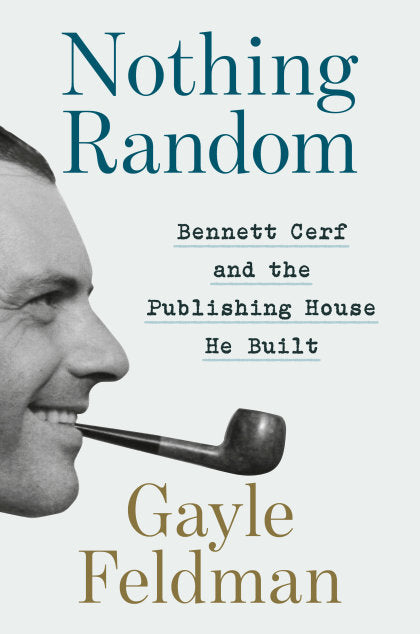
Nothing Random
Nothing Random
Couldn't load pickup availability
Collapsible content
ABOUT
“[A] big, beautiful biography . . . There’s a new Power Broker in town.”—The New York Times
“Feldman depicts a lost world, at times a lost paradise, when New York, Hollywood and the literary life were at their most glamorous and privileged.”—The Washington Post
At midcentury, everyone knew Bennett Cerf: witty, beloved, middle-aged panelist on What’s My Line? whom TV brought into America’s homes each week. But they didn’t know that the handsome, driven, paradoxical young man of the 1920s had vowed to become a great publisher and, a decade later, was. By then, he’d signed Eugene O’Neill, Gertrude Stein, and William Faulkner, and had fought the landmark censorship case that gave Americans the freedom to read James Joyce’s Ulysses.
With his best friend and lifelong business partner Donald Klopfer, and other young Jewish entrepreneurs like the Knopfs and Simon & Schuster, Cerf remade the book business: what was published, and how. In 1925, he and Klopfer bought the Modern Library and turned it into an institution, then founded Random House, which eventually became a home to Truman Capote, Ralph Ellison, Ayn Rand, Dr. Seuss, Toni Morrison, James Michener, and many more.
Even before TV, Cerf was a bestselling author and columnist as well as publisher; the show super-charged his celebrity, bringing fame—but also criticism. A brilliant social networker and major influencer before such terms existed, he connected books to Broadway, TV, Hollywood, and politics. A fervent democratizer, he published “high,” “low,” and wide, and from the Roaring Twenties to the Swinging Sixties collected an incredible array of friends, from George Gershwin to Frank Sinatra, having a fabulous time along the way.
Using interviews with more than two hundred individuals, deeply researched archival material, and letters from private collections not previously available, this book brings Bennett Cerf to vibrant life, drawing book lovers into his world, finally laying open the page on a quintessential American original.
STANDARD, PRIMARY, DM AND VARIANT COVERS
Standard and Primary covers are widely available through general retailers. They often have higher print runs and can be cheaper, especially during sales.
In contrast, Direct Market (DM) and variant covers are primarily sold in comic shops. DM editions tend to have more limited availability and may be more valuable to collectors.
The main differences lie in artwork style, availability, price, and collector appeal. Ultimately, the choice between standard and variant covers depends on personal preference, budget, and individual collecting goals.
PRODUCT TYPES
Comic book enthusiasts have various formats to choose from when collecting their favorite stories.
Here's a brief overview of the main types:
Omnibus
- Large, hardcover collections
- Usually contain complete runs or extensive story arcs
- Typically 800-1000+ pages
- Higher price point, often €100-€150
Oversized Hardcover (OHC)
- Similar dimensions to omnibus, but thinner
- Collect shorter runs or story arcs
- Usually 300-600 pages
- Priced between €30-€50
Hardcover (HC)
- Standard-sized hardcover books
- Collect 6-12 issues typically
- Similar dimensions to single issues, but with a hard cover
- Priced around €25-€35
Trade Paperback (TP)
- Softcover collections
- Standard comic book size
- Usually collect 4-6 issues
- Most affordable option, typically €15-€25
Other Formats
- Absolute Editions: Oversized, deluxe hardcovers (mainly DC Comics)
- Compendiums: Massive paperback collections
- Graphic Novels (OGN/GN): Original stories not previously released as single issues
The choice between these formats often depends on personal preference, budget, and collecting goals. Omnibus and OHC editions offer larger artwork and more content but at a higher price, while TPs provide a more affordable way to collect complete story arcs