

Random House Publishing Group
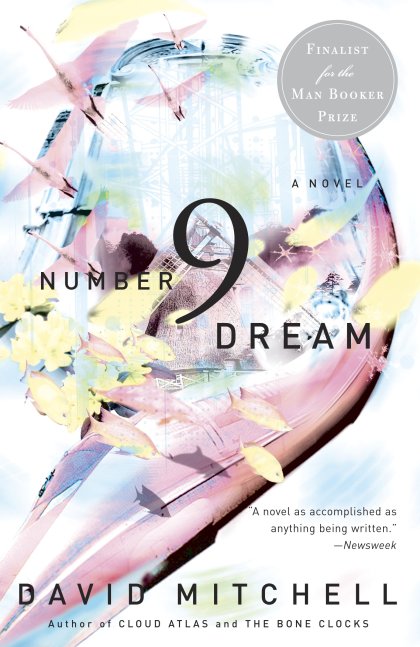
Number9Dream
Number9Dream
Couldn't load pickup availability
Collapsible content
ABOUT
“A novel as accomplished as anything being written.”—Newsweek
Number9Dream is the international literary sensation from a writer with astonishing range and imaginative energy—an intoxicating ride through Tokyo’s dark underworlds and the even more mysterious landscapes of our collective dreams.
David Mitchell follows his eerily precocious, globe-striding first novel, Ghostwritten, with a work that is in its way even more ambitious. In outward form, Number9Dream is a Dickensian coming-of-age journey: Young dreamer Eiji Miyake, from remote rural Japan, thrust out on his own by his sister’s death and his mother’s breakdown, comes to Tokyo in pursuit of the father who abandoned him. Stumbling around this strange, awesome city, he trips over and crosses—through a hidden destiny or just monstrously bad luck—a number of its secret power centers. Suddenly, the riddle of his father’s identity becomes just one of the increasingly urgent questions Eiji must answer. Why is the line between the world of his experiences and the world of his dreams so blurry? Why do so many horrible things keep happening to him? What is it about the number 9? To answer these questions, and ultimately to come to terms with his inheritance, Eiji must somehow acquire an insight into the workings of history and fate that would be rare in anyone, much less in a boy from out of town with a price on his head and less than the cost of a Beatles disc to his name.
Praise for Number9Dream
“Delirious—a grand blur of overwhelming sensation.”—Entertainment Weekly
“To call Mitchell’s book a simple quest novel . . is like calling Don DeLillo’s Underworld the story of a missing baseball.”—The New York Times Book Review
“Number9Dream, with its propulsive energy, its Joycean eruption of language and playfulness, represents further confirmation that David Mitchell should be counted among the top young novelists working today.”—San Francisco Chronicle
“Mitchell’s new novel has been described as a cross between Don DeLillo and William Gibson, and although that’s a perfectly serviceable cocktail-party formula, it doesn’t do justice to this odd, fitfully compelling work.”—The New Yorker
“Leaping with ease from surrealist fables to a teenage coming-of-age story and then spinning back to Yakuza gangster battles and World War II–era kamikaze diaries, Mitchell is an aerial freestyle ski-jumper of fiction. Somehow, after performing feats of literary gymnastics, he manages to stick the landing.”—The Seattle Post-Intelligencer
STANDARD, PRIMARY, DM AND VARIANT COVERS
Standard and Primary covers are widely available through general retailers. They often have higher print runs and can be cheaper, especially during sales.
In contrast, Direct Market (DM) and variant covers are primarily sold in comic shops. DM editions tend to have more limited availability and may be more valuable to collectors.
The main differences lie in artwork style, availability, price, and collector appeal. Ultimately, the choice between standard and variant covers depends on personal preference, budget, and individual collecting goals.
PRODUCT TYPES
Comic book enthusiasts have various formats to choose from when collecting their favorite stories.
Here's a brief overview of the main types:
Omnibus
- Large, hardcover collections
- Usually contain complete runs or extensive story arcs
- Typically 800-1000+ pages
- Higher price point, often €100-€150
Oversized Hardcover (OHC)
- Similar dimensions to omnibus, but thinner
- Collect shorter runs or story arcs
- Usually 300-600 pages
- Priced between €30-€50
Hardcover (HC)
- Standard-sized hardcover books
- Collect 6-12 issues typically
- Similar dimensions to single issues, but with a hard cover
- Priced around €25-€35
Trade Paperback (TP)
- Softcover collections
- Standard comic book size
- Usually collect 4-6 issues
- Most affordable option, typically €15-€25
Other Formats
- Absolute Editions: Oversized, deluxe hardcovers (mainly DC Comics)
- Compendiums: Massive paperback collections
- Graphic Novels (OGN/GN): Original stories not previously released as single issues
The choice between these formats often depends on personal preference, budget, and collecting goals. Omnibus and OHC editions offer larger artwork and more content but at a higher price, while TPs provide a more affordable way to collect complete story arcs