

Penguin Publishing Group
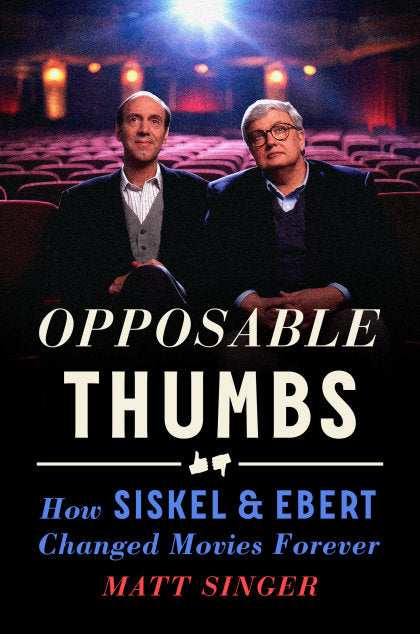
Opposable Thumbs
Opposable Thumbs
Couldn't load pickup availability
Collapsible content
ABOUT
You asked whether Siskel & Ebert had given it “two thumbs up.”
On a cold Saturday afternoon in 1975, two men (who had known each other for eight years before they’d ever exchanged a word) met for lunch in a Chicago pub. Gene Siskel was the film critic for the Chicago Tribune. Roger Ebert had recently won the Pulitzer Prize—the first ever awarded to a film critic—for his work at the Chicago Sun-Times. To say they despised each other was an understatement.
When they reluctantly agreed to collaborate on a new movie review show with PBS, there was at least as much sparring off-camera as on. No decision—from which films to cover to who would read the lead review to how to pronounce foreign titles—was made without conflict, but their often-antagonistic partnership (which later transformed into genuine friendship) made for great television. In the years that followed, their signature “Two thumbs up!” would become the most trusted critical brand in Hollywood.
In Opposable Thumbs, award-winning editor and film critic Matt Singer eavesdrops on their iconic balcony set, detailing their rise from making a few hundred dollars a week on local Chicago PBS to securing multimillion-dollar contracts for a syndicated series (a move that convinced a young local host named Oprah Winfrey to do the same). Their partnership was cut short when Gene Siskel passed away in February of 1999 after a battle with brain cancer that he’d kept secret from everyone outside his immediate family—including Roger Ebert, who never got to say goodbye to his longtime partner. But their influence on in the way we talk about (and think about) movies continues to this day.
STANDARD, PRIMARY, DM AND VARIANT COVERS
Standard and Primary covers are widely available through general retailers. They often have higher print runs and can be cheaper, especially during sales.
In contrast, Direct Market (DM) and variant covers are primarily sold in comic shops. DM editions tend to have more limited availability and may be more valuable to collectors.
The main differences lie in artwork style, availability, price, and collector appeal. Ultimately, the choice between standard and variant covers depends on personal preference, budget, and individual collecting goals.
PRODUCT TYPES
Comic book enthusiasts have various formats to choose from when collecting their favorite stories.
Here's a brief overview of the main types:
Omnibus
- Large, hardcover collections
- Usually contain complete runs or extensive story arcs
- Typically 800-1000+ pages
- Higher price point, often €100-€150
Oversized Hardcover (OHC)
- Similar dimensions to omnibus, but thinner
- Collect shorter runs or story arcs
- Usually 300-600 pages
- Priced between €30-€50
Hardcover (HC)
- Standard-sized hardcover books
- Collect 6-12 issues typically
- Similar dimensions to single issues, but with a hard cover
- Priced around €25-€35
Trade Paperback (TP)
- Softcover collections
- Standard comic book size
- Usually collect 4-6 issues
- Most affordable option, typically €15-€25
Other Formats
- Absolute Editions: Oversized, deluxe hardcovers (mainly DC Comics)
- Compendiums: Massive paperback collections
- Graphic Novels (OGN/GN): Original stories not previously released as single issues
The choice between these formats often depends on personal preference, budget, and collecting goals. Omnibus and OHC editions offer larger artwork and more content but at a higher price, while TPs provide a more affordable way to collect complete story arcs