

Penguin Publishing Group
Orwell's Roses
Orwell's Roses
Couldn't load pickup availability
Collapsible content
ABOUT
Finalist for the PEN/Jacqueline Bograd Weld Award for Biography
“An exhilarating romp through Orwell’s life and times and also through the life and times of roses.” —Margaret Atwood
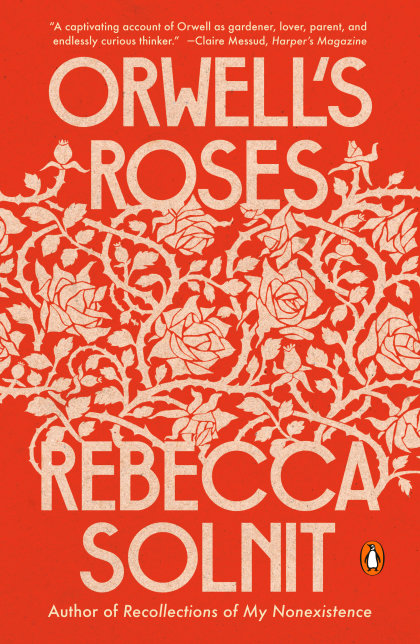
“A captivating account of Orwell as gardener, lover, parent, and endlessly curious thinker.” —Claire Messud, Harper's
“Nobody who reads it will ever think of Nineteen Eighty-Four in quite the same way.” —Vogue
A lush exploration of politics, roses, and pleasure, and a fresh take on George Orwell as an avid gardener whose political writing was grounded by his passion for the natural world
“In the spring of 1936, a writer planted roses.” So be-gins Rebecca Solnit’s new book, a reflection on George Orwell’s passionate gardening and the way that his involvement with plants, particularly flowers, illuminates his other commitments as a writer and antifascist, and on the intertwined politics of nature and power.
Sparked by her unexpected encounter with the roses he reportedly planted in 1936, Solnit’s account of this overlooked aspect of Orwell’s life journeys through his writing and his actions—from going deep into the coal mines of England, fighting in the Spanish Civil War, critiquing Stalin when much of the international left still supported him (and then critiquing that left) to his analysis of the relationship between lies and authoritarianism.
Through Solnit’s celebrated ability to draw unexpected connections, readers are drawn onward from Orwell‘s own work as a writer and gardener to encounter photographer Tina Modotti’s roses and her politics, agriculture and illusion in the USSR of his time with forcing lemons to grow in impossibly cold conditions, Orwell’s slave-owning ancestors in Jamaica, Jamaica Kincaid’s examination of colonialism and imperialism in the flower garden, and the brutal rose industry in Colombia that supplies the American market. The book draws to a close with a rereading of Nineteen Eighty-Four that completes Solnit’s portrait of a more hopeful Orwell, as well as offering a meditation on pleasure, beauty, and joy as acts of resistance.
STANDARD, PRIMARY, DM AND VARIANT COVERS
Standard and Primary covers are widely available through general retailers. They often have higher print runs and can be cheaper, especially during sales.
In contrast, Direct Market (DM) and variant covers are primarily sold in comic shops. DM editions tend to have more limited availability and may be more valuable to collectors.
The main differences lie in artwork style, availability, price, and collector appeal. Ultimately, the choice between standard and variant covers depends on personal preference, budget, and individual collecting goals.
PRODUCT TYPES
Comic book enthusiasts have various formats to choose from when collecting their favorite stories.
Here's a brief overview of the main types:
Omnibus
- Large, hardcover collections
- Usually contain complete runs or extensive story arcs
- Typically 800-1000+ pages
- Higher price point, often €100-€150
Oversized Hardcover (OHC)
- Similar dimensions to omnibus, but thinner
- Collect shorter runs or story arcs
- Usually 300-600 pages
- Priced between €30-€50
Hardcover (HC)
- Standard-sized hardcover books
- Collect 6-12 issues typically
- Similar dimensions to single issues, but with a hard cover
- Priced around €25-€35
Trade Paperback (TP)
- Softcover collections
- Standard comic book size
- Usually collect 4-6 issues
- Most affordable option, typically €15-€25
Other Formats
- Absolute Editions: Oversized, deluxe hardcovers (mainly DC Comics)
- Compendiums: Massive paperback collections
- Graphic Novels (OGN/GN): Original stories not previously released as single issues
The choice between these formats often depends on personal preference, budget, and collecting goals. Omnibus and OHC editions offer larger artwork and more content but at a higher price, while TPs provide a more affordable way to collect complete story arcs