

Beacon Press
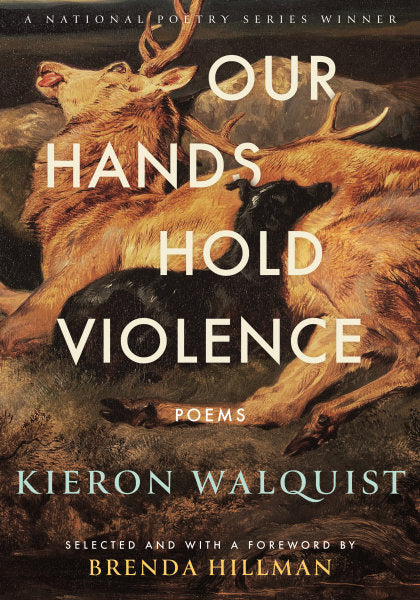
Our Hands Hold Violence
Our Hands Hold Violence
Couldn't load pickup availability
Collapsible content
ABOUT
A collection of poems that explores rural Missouri, violence, queer desire / intimacy, addiction, familial and wildlife relationships
Through encounters with the everyday beauty and brutality so much a part of rural and urban Missouri, Our Hands Hold Violence explores what it means to experience and/or perpetuate small and significant acts of violence, toward others and the self.
What does it mean to hunt (be hunted), haunt (be haunted), and other (be othered)? Abiding by a chronological arc told in four movements (HERE, THERE, TOGETHER, ALONE), OHHV follows the speaker(s) as they come up in the Show Me State and come to terms with queerness, mental disability, addiction, and loneliness in the largely Christian, conservative, and hyper-masculine landscape. Other themes / aspects of note include familial dynamics, estrangement, labor, neglected and decaying natures, waste, and the confluence of wildlife and mankind.
Comprised of traditional forms and modes such as the abecedarian, ekphrasis, sestina, and more hybrid configurations (billboards, bullet points, McDonald’s Monopoly stickers), as well as photographs, OHHV is interested, too, in changing/challenging structure and expectations. Thus, enacting a visual and figurative “violence” upon the page. Additionally, two poems are contained in a nonce (invented) form called “Shakes,” where strophes traverse between left and right points, while the middle column is constructed or cataloged by similar sounds—a form inspired by the author’s own reality of stimming (i.e. pacing) and echolalia.
OHHV indulges in alliteration, assonance, repetition, and a colloquial registry of language. The voice(s) in the poems can range from anxious, reflective (nostalgic), sensual, and tender, but all are compelled by and circle the manuscript’s themes, which become obsessions. Hauntings. Ultimately, OHHV is a collection troubled by the desire to belong to/in a place and to beloveds that have “been home” while, in ways, “feeling like an outsider” at home and within one’s local community.
STANDARD, PRIMARY, DM AND VARIANT COVERS
Standard and Primary covers are widely available through general retailers. They often have higher print runs and can be cheaper, especially during sales.
In contrast, Direct Market (DM) and variant covers are primarily sold in comic shops. DM editions tend to have more limited availability and may be more valuable to collectors.
The main differences lie in artwork style, availability, price, and collector appeal. Ultimately, the choice between standard and variant covers depends on personal preference, budget, and individual collecting goals.
PRODUCT TYPES
Comic book enthusiasts have various formats to choose from when collecting their favorite stories.
Here's a brief overview of the main types:
Omnibus
- Large, hardcover collections
- Usually contain complete runs or extensive story arcs
- Typically 800-1000+ pages
- Higher price point, often €100-€150
Oversized Hardcover (OHC)
- Similar dimensions to omnibus, but thinner
- Collect shorter runs or story arcs
- Usually 300-600 pages
- Priced between €30-€50
Hardcover (HC)
- Standard-sized hardcover books
- Collect 6-12 issues typically
- Similar dimensions to single issues, but with a hard cover
- Priced around €25-€35
Trade Paperback (TP)
- Softcover collections
- Standard comic book size
- Usually collect 4-6 issues
- Most affordable option, typically €15-€25
Other Formats
- Absolute Editions: Oversized, deluxe hardcovers (mainly DC Comics)
- Compendiums: Massive paperback collections
- Graphic Novels (OGN/GN): Original stories not previously released as single issues
The choice between these formats often depends on personal preference, budget, and collecting goals. Omnibus and OHC editions offer larger artwork and more content but at a higher price, while TPs provide a more affordable way to collect complete story arcs