

Knopf Doubleday Publishing Group
Our Kindred Creatures
Our Kindred Creatures
Couldn't load pickup availability
Collapsible content
ABOUT
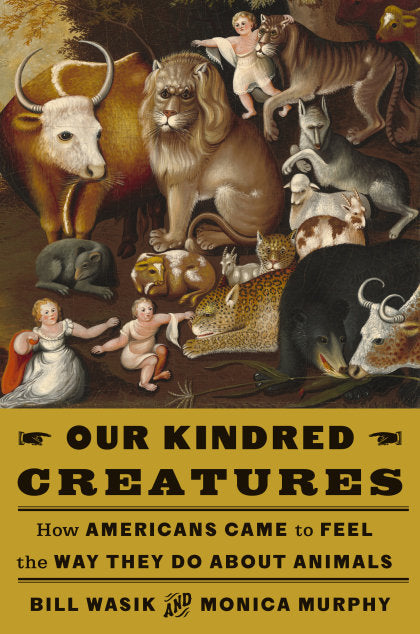
Over just a few decades at the end of the nineteenth century, the United States underwent a moral revolution on behalf of animals. Before the Civil War, animals' suffering had rarely been discussed; horses pulling carriages and carts were routinely beaten in public view, and dogs were pitted against each other for entertainment and gambling. But in 1866, a group of activists began a dramatic campaign to change the nation’s laws and norms, and by the century’s end, most Americans had adopted a very different way of thinking and feeling about the animals in their midst.
In Our Kindred Creatures, Bill Wasik, editorial director of The New York Times Magazine, and veterinarian Monica Murphy offer a fascinating history of this crusade and the battles it sparked in American life. On the side of reform were such leaders as George Angell, the inspirational head of Massachusetts’s animal-welfare society and the American publisher of the novel Black Beauty; Henry Bergh, founder of the American Society for the Prevention of Cruelty to Animals; Caroline White of Philadelphia, who fought against medical experiments that used live animals; and many more, including some of the nation’s earliest veterinarians and conservationists. Caught in the movement’s crosshairs were transformational figures in their own right: animal impresarios such as P. T. Barnum, industrial meat barons such as Philip D. Armour, and the nation’s rising medical establishment, all of whom put forward their own, very different sets of modern norms about how animals should be treated.
In recounting this remarkable period of moral transition—which, by the turn of the twentieth century, would give birth to the attitudes we hold toward animals today—Wasik and Murphy challenge us to consider the obligations we still have to all our kindred creatures.
STANDARD, PRIMARY, DM AND VARIANT COVERS
Standard and Primary covers are widely available through general retailers. They often have higher print runs and can be cheaper, especially during sales.
In contrast, Direct Market (DM) and variant covers are primarily sold in comic shops. DM editions tend to have more limited availability and may be more valuable to collectors.
The main differences lie in artwork style, availability, price, and collector appeal. Ultimately, the choice between standard and variant covers depends on personal preference, budget, and individual collecting goals.
PRODUCT TYPES
Comic book enthusiasts have various formats to choose from when collecting their favorite stories.
Here's a brief overview of the main types:
Omnibus
- Large, hardcover collections
- Usually contain complete runs or extensive story arcs
- Typically 800-1000+ pages
- Higher price point, often €100-€150
Oversized Hardcover (OHC)
- Similar dimensions to omnibus, but thinner
- Collect shorter runs or story arcs
- Usually 300-600 pages
- Priced between €30-€50
Hardcover (HC)
- Standard-sized hardcover books
- Collect 6-12 issues typically
- Similar dimensions to single issues, but with a hard cover
- Priced around €25-€35
Trade Paperback (TP)
- Softcover collections
- Standard comic book size
- Usually collect 4-6 issues
- Most affordable option, typically €15-€25
Other Formats
- Absolute Editions: Oversized, deluxe hardcovers (mainly DC Comics)
- Compendiums: Massive paperback collections
- Graphic Novels (OGN/GN): Original stories not previously released as single issues
The choice between these formats often depends on personal preference, budget, and collecting goals. Omnibus and OHC editions offer larger artwork and more content but at a higher price, while TPs provide a more affordable way to collect complete story arcs