

Random House Publishing Group
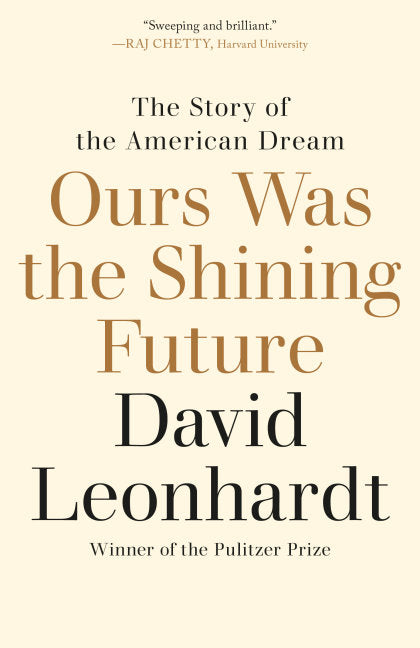
Ours Was the Shining Future
Ours Was the Shining Future
Couldn't load pickup availability
Collapsible content
ABOUT
“With the even-handed incisiveness that has made him one of the country’s most-respected voices on economics, David Leonhardt illuminates the inside history of the players and missteps that have stolen so many Americans’ futures.”—Jane Mayer, author of Dark Money
NEW YORK TIMES BOOK REVIEW EDITORS’ CHOICE • ONE OF THE ATLANTIC’S TEN BEST BOOKS OF THE YEAR • A FINANCIAL TIMES BEST BOOK OF THE YEAR
Two decades into the twenty-first century, the stagnation of living standards has become the defining trend of American life. Life expectancy has declined, economic inequality has soared, and, after some progress, the Black-white wage gap is once again as large as it was in the 1950s. How did this happen in the world’s most powerful country? And what happened to the “American dream”—the promise of a happier, healthier, more prosperous future—which was once such an inextricable part of our national identity?
Drawing on decades of writing about the economy for The New York Times, Pulitzer Prize–winning writer David Leonhardt examines the past century of American history, from the Great Depression to today’s Great Stagnation, in search of an answer.
To make sense of the rise and subsequent fall of the American dream, Leonhardt tells the story of the modern American economy as an ongoing battle between two competing forms of capitalism: one that envisions prosperity for most, and one that serves the individual and favors the wealthy. In vivid prose, Ours Was the Shining Future traces how democratic capitalism flourished to make the American dream possible, until the latter decades of the twentieth century when, bit by bit, the dream was corrupted to serve only the privileged few.
Ours Was the Shining Future is a sweeping narrative full of innovation and grit, human drama and hope. Featuring the trailblazing figures who helped shape the American dream—Frances Perkins, Paul Hoffman, Cesar Chavez, Robert Kennedy, A. Philip Randolph, Grace Hopper, and more—this engaging history reveals the power of grassroots democratic movements from across the political spectrum. And though the American dream feels lost to us now, Leonhardt shows how Americans—if they commit themselves to transforming the economy, as they did in the past—have the power to revive the dream once more.
STANDARD, PRIMARY, DM AND VARIANT COVERS
Standard and Primary covers are widely available through general retailers. They often have higher print runs and can be cheaper, especially during sales.
In contrast, Direct Market (DM) and variant covers are primarily sold in comic shops. DM editions tend to have more limited availability and may be more valuable to collectors.
The main differences lie in artwork style, availability, price, and collector appeal. Ultimately, the choice between standard and variant covers depends on personal preference, budget, and individual collecting goals.
PRODUCT TYPES
Comic book enthusiasts have various formats to choose from when collecting their favorite stories.
Here's a brief overview of the main types:
Omnibus
- Large, hardcover collections
- Usually contain complete runs or extensive story arcs
- Typically 800-1000+ pages
- Higher price point, often €100-€150
Oversized Hardcover (OHC)
- Similar dimensions to omnibus, but thinner
- Collect shorter runs or story arcs
- Usually 300-600 pages
- Priced between €30-€50
Hardcover (HC)
- Standard-sized hardcover books
- Collect 6-12 issues typically
- Similar dimensions to single issues, but with a hard cover
- Priced around €25-€35
Trade Paperback (TP)
- Softcover collections
- Standard comic book size
- Usually collect 4-6 issues
- Most affordable option, typically €15-€25
Other Formats
- Absolute Editions: Oversized, deluxe hardcovers (mainly DC Comics)
- Compendiums: Massive paperback collections
- Graphic Novels (OGN/GN): Original stories not previously released as single issues
The choice between these formats often depends on personal preference, budget, and collecting goals. Omnibus and OHC editions offer larger artwork and more content but at a higher price, while TPs provide a more affordable way to collect complete story arcs