

Penguin Publishing Group
Out Loud
Out Loud
Couldn't load pickup availability
Collapsible content
ABOUT
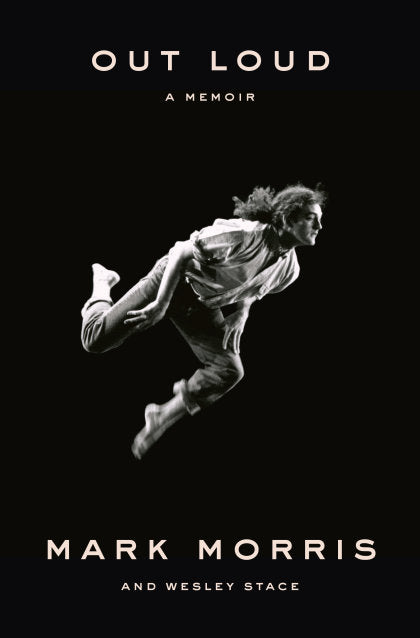
Before Mark Morris became “the most successful and influential choreographer alive” (The New York Times), he was a six year-old in Seattle cramming his feet into Tupperware glasses so that he could practice walking on pointe. Often the only boy in the dance studio, he was called a sissy, a term he wore like a badge of honor. He was unlike anyone else, deeply gifted and spirited.
Moving to New York at nineteen, he arrived to one of the great booms of dance in America. Audiences in 1976 had the luxury of Merce Cunningham’s finest experiments with time and space, of Twyla Tharp’s virtuosity, and Lucinda Childs's genius. Morris was flat broke but found a group of likeminded artists that danced together, travelled together, slept together. No one wanted to break the spell or miss a thing, because “if you missed anything, you missed everything.” This collective, led by Morris’s fiercely original vision, became the famed Mark Morris Dance Group.
Suddenly, Morris was making a fast ascent. Celebrated by The New Yorker’s critic as one of the great young talents, an androgynous beauty in the vein of Michelangelo’s David, he and his company had arrived. Collaborations with the likes of Mikhail Baryshnikov, Yo-Yo Ma, Lou Harrison, and Howard Hodgkin followed. And so did controversy: from the circus of his tenure at La Monnaie in Belgium to his work on the biggest flop in Broadway history. But through the Reagan-Bush era, the worst of the AIDS epidemic, through rehearsal squabbles and backstage intrigues, Morris emerged as one of the great visionaries of modern dance, a force of nature with a dedication to beauty and a love of the body, an artist as joyful as he is provocative.
Out Loud is the bighearted and outspoken story of a man as formidable on the page as he is on the boards. With unusual candor and disarming wit, Morris’s memoir captures the life of a performer who broke the mold, a brilliant maverick who found his home in the collective and liberating world of music and dance.
STANDARD, PRIMARY, DM AND VARIANT COVERS
Standard and Primary covers are widely available through general retailers. They often have higher print runs and can be cheaper, especially during sales.
In contrast, Direct Market (DM) and variant covers are primarily sold in comic shops. DM editions tend to have more limited availability and may be more valuable to collectors.
The main differences lie in artwork style, availability, price, and collector appeal. Ultimately, the choice between standard and variant covers depends on personal preference, budget, and individual collecting goals.
PRODUCT TYPES
Comic book enthusiasts have various formats to choose from when collecting their favorite stories.
Here's a brief overview of the main types:
Omnibus
- Large, hardcover collections
- Usually contain complete runs or extensive story arcs
- Typically 800-1000+ pages
- Higher price point, often €100-€150
Oversized Hardcover (OHC)
- Similar dimensions to omnibus, but thinner
- Collect shorter runs or story arcs
- Usually 300-600 pages
- Priced between €30-€50
Hardcover (HC)
- Standard-sized hardcover books
- Collect 6-12 issues typically
- Similar dimensions to single issues, but with a hard cover
- Priced around €25-€35
Trade Paperback (TP)
- Softcover collections
- Standard comic book size
- Usually collect 4-6 issues
- Most affordable option, typically €15-€25
Other Formats
- Absolute Editions: Oversized, deluxe hardcovers (mainly DC Comics)
- Compendiums: Massive paperback collections
- Graphic Novels (OGN/GN): Original stories not previously released as single issues
The choice between these formats often depends on personal preference, budget, and collecting goals. Omnibus and OHC editions offer larger artwork and more content but at a higher price, while TPs provide a more affordable way to collect complete story arcs