

Random House Publishing Group
Pain Killer
Pain Killer
Couldn't load pickup availability
Collapsible content
ABOUT
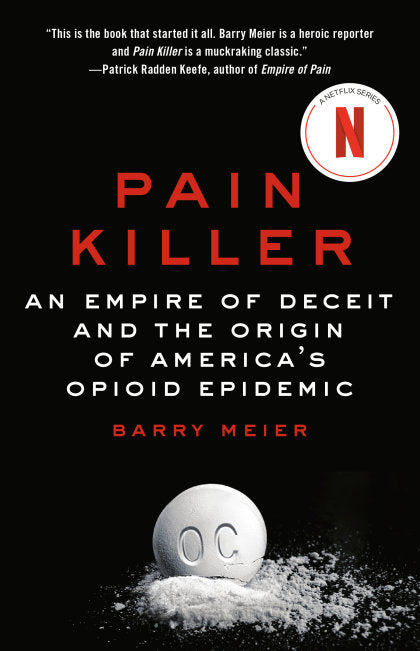
“This is the book that started it all. Barry Meier is a heroic reporter and Pain Killer is a muckraking classic.”—Patrick Radden Keefe, author of Empire of Pain
New York Times Book Review Editors’ Choice
Between 1999 and 2017, an estimated 250,000 Americans died from overdoses involving prescription painkillers, a plague ignited by Purdue Pharma’s aggressive marketing of OxyContin. Families, working class and wealthy, have been torn apart, businesses destroyed, and public officials pushed to the brink. Meanwhile, the drugmaker’s owners, Raymond and Mortimer Sackler, whose names adorn museums worldwide, made enormous fortunes from the commercial success of OxyContin.
In Pain Killer, Barry Meier tells the story of how Purdue turned OxyContin into a billion-dollar blockbuster. Powerful narcotic painkillers, or opioids, were once used as drugs of last resort for pain sufferers. But Purdue launched an unprecedented marketing campaign claiming that the drug’s long-acting formulation made it safer to use than traditional painkillers for many types of pain. That illusion was quickly shattered as drug abusers learned that crushing an Oxy could release its narcotic payload all at once. Even in its prescribed form, Oxy proved fiercely addictive. As OxyContin’s use and abuse grew, Purdue concealed what it knew from regulators, doctors, and patients.
Here are the people who profited from the crisis and those who paid the price, those who plotted in boardrooms and those who tried to sound alarm bells. A country doctor in rural Virginia, Art Van Zee, took on Purdue and warned officials about OxyContin abuse. An ebullient high school cheerleader, Lindsey Myers, was reduced to stealing from her parents to feed her escalating Oxy habit. A hard-charging DEA official, Laura Nagel, tried to hold Purdue executives to account.
In Pain Killer, Barry Meier breaks new ground in his decades-long investigation into the opioid epidemic. He takes readers inside Purdue to show how long the company withheld information about the abuse of OxyContin and gives a shocking account of the Justice Department’s failure to alter the trajectory of the opioid epidemic and protect thousands of lives. Equal parts crime thriller, medical detective story, and business exposé, Pain Killer is a hard-hitting look at how a supposed wonder drug became the gateway drug to a national tragedy.
STANDARD, PRIMARY, DM AND VARIANT COVERS
Standard and Primary covers are widely available through general retailers. They often have higher print runs and can be cheaper, especially during sales.
In contrast, Direct Market (DM) and variant covers are primarily sold in comic shops. DM editions tend to have more limited availability and may be more valuable to collectors.
The main differences lie in artwork style, availability, price, and collector appeal. Ultimately, the choice between standard and variant covers depends on personal preference, budget, and individual collecting goals.
PRODUCT TYPES
Comic book enthusiasts have various formats to choose from when collecting their favorite stories.
Here's a brief overview of the main types:
Omnibus
- Large, hardcover collections
- Usually contain complete runs or extensive story arcs
- Typically 800-1000+ pages
- Higher price point, often €100-€150
Oversized Hardcover (OHC)
- Similar dimensions to omnibus, but thinner
- Collect shorter runs or story arcs
- Usually 300-600 pages
- Priced between €30-€50
Hardcover (HC)
- Standard-sized hardcover books
- Collect 6-12 issues typically
- Similar dimensions to single issues, but with a hard cover
- Priced around €25-€35
Trade Paperback (TP)
- Softcover collections
- Standard comic book size
- Usually collect 4-6 issues
- Most affordable option, typically €15-€25
Other Formats
- Absolute Editions: Oversized, deluxe hardcovers (mainly DC Comics)
- Compendiums: Massive paperback collections
- Graphic Novels (OGN/GN): Original stories not previously released as single issues
The choice between these formats often depends on personal preference, budget, and collecting goals. Omnibus and OHC editions offer larger artwork and more content but at a higher price, while TPs provide a more affordable way to collect complete story arcs