

Knopf Doubleday Publishing Group
Paradise Falls
Paradise Falls
Couldn't load pickup availability
Collapsible content
ABOUT
“Propulsive...A mighty work of historical journalism...A glorious quotidian thriller about people forced to find and use their inner strength.” —The Boston Globe
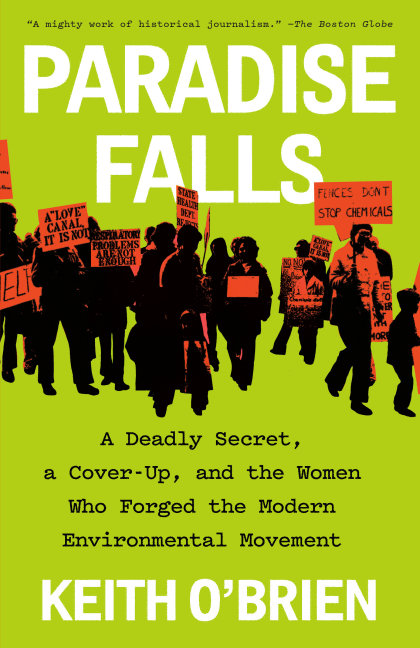
Lois Gibbs, Luella Kenny, and other mothers loved their neighborhood on the east side of Niagara Falls. It had an elementary school, a playground, and rows of affordable homes. But in the spring of 1977, pungent odors began to seep into these little houses, and it didn’t take long for worried mothers to identify the curious scent. It was the sickly sweet smell of chemicals.
In this propulsive work of narrative storytelling, NYT journalist Keith O’Brien uncovers how Gibbs and Kenny exposed the poisonous secrets buried in their neighborhood. The school and playground had been built atop an old canal—Love Canal, it was called—that Hooker Chemical, the city’s largest employer, had quietly filled with twenty thousand tons of toxic waste in the 1940s and 1950s. This waste was now leaching to the surface, causing a public health crisis the likes of which America had never seen before and sparking new and specific fears. Luella Kenny believed the chemicals were making her son sick.
O’Brien braids together previously unknown stories of Hooker Chemical’s deeds; the local newspaperman, scientist, and congressional staffer who tried to help; the city and state officials who didn’t; and the heroic women who stood up to corporate and governmental indifference to save their families and their children. They would take their fight all the way to the top, winning support from the EPA, the White House, and even President Jimmy Carter. By the time it was over, they would capture America’s imagination.
Sweeping and electrifying, Paradise Falls brings to life a defining story from our past, laying bare the dauntless efforts of a few women who—years before Erin Brockovich took up the mantle— fought to rescue their community and their lives from the effects of corporate pollution and laid foundation for the modern environmental movement as we know it today.
STANDARD, PRIMARY, DM AND VARIANT COVERS
Standard and Primary covers are widely available through general retailers. They often have higher print runs and can be cheaper, especially during sales.
In contrast, Direct Market (DM) and variant covers are primarily sold in comic shops. DM editions tend to have more limited availability and may be more valuable to collectors.
The main differences lie in artwork style, availability, price, and collector appeal. Ultimately, the choice between standard and variant covers depends on personal preference, budget, and individual collecting goals.
PRODUCT TYPES
Comic book enthusiasts have various formats to choose from when collecting their favorite stories.
Here's a brief overview of the main types:
Omnibus
- Large, hardcover collections
- Usually contain complete runs or extensive story arcs
- Typically 800-1000+ pages
- Higher price point, often €100-€150
Oversized Hardcover (OHC)
- Similar dimensions to omnibus, but thinner
- Collect shorter runs or story arcs
- Usually 300-600 pages
- Priced between €30-€50
Hardcover (HC)
- Standard-sized hardcover books
- Collect 6-12 issues typically
- Similar dimensions to single issues, but with a hard cover
- Priced around €25-€35
Trade Paperback (TP)
- Softcover collections
- Standard comic book size
- Usually collect 4-6 issues
- Most affordable option, typically €15-€25
Other Formats
- Absolute Editions: Oversized, deluxe hardcovers (mainly DC Comics)
- Compendiums: Massive paperback collections
- Graphic Novels (OGN/GN): Original stories not previously released as single issues
The choice between these formats often depends on personal preference, budget, and collecting goals. Omnibus and OHC editions offer larger artwork and more content but at a higher price, while TPs provide a more affordable way to collect complete story arcs