

Crown
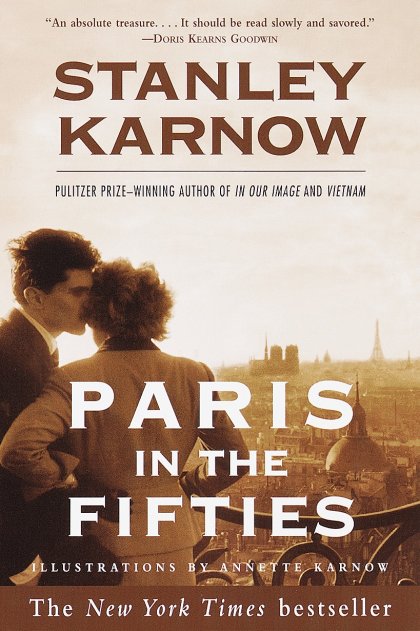
Paris in the Fifties
Paris in the Fifties
Couldn't load pickup availability
Collapsible content
ABOUT
Now, Karnow returns to the France of his youth, perceptively and wittily illuminating a time and place like none other. Karnow came to France at a time when the French were striving to return to the life they had enjoyed before the devastation of World War II. Yet even during food shortages, political upheavals, and the struggle to come to terms with a world in which France was no longer the mighty power it had been, Paris remained a city of style, passion, and romance.
Paris in the Fifties transports us to Latin Quarter cafés and basement jazz clubs, to unheated apartments and glorious ballrooms. We meet such prominent political figures as Charles de Gaulle and Pierre Mendès-France, as well as Communist hacks and the demagogic tax rebel Pierre Poujade. We get to know illustrious intellectuals, among them Jean-Paul Sartre, Simone de Beauvoir, Albert Camus, and André Malraux, and visit the glittering salons where aristocrats with exquisite manners mingled with trendy novelists, poets, critics, artists, composers, playwrights, and actors. We meet Christian Dior, who taught Karnow the secrets of haute couture, and Prince Curnonsky, France's leading gourmet, who taught the young reporter to appreciate the complexities of haute cuisine. Karnow takes us to marathon murder trials in musty courtrooms, accompanies a group of tipsy wine connoisseurs on a tour of the Beaujolais vineyards, and recalls the famous automobile race at Le Mans when a catastrophic accident killed more than eighty spectators. Back in Paris, Karnow hung out with visiting celebrities like Ernest Hemingway, Orson Welles, and Audrey Hepburn, and in Paris in the Fifties we meet them too.
A veteran reporter and historian, Karnow has written a vivid and delightful history of a charmed decade in the greatest city in the world.
STANDARD, PRIMARY, DM AND VARIANT COVERS
Standard and Primary covers are widely available through general retailers. They often have higher print runs and can be cheaper, especially during sales.
In contrast, Direct Market (DM) and variant covers are primarily sold in comic shops. DM editions tend to have more limited availability and may be more valuable to collectors.
The main differences lie in artwork style, availability, price, and collector appeal. Ultimately, the choice between standard and variant covers depends on personal preference, budget, and individual collecting goals.
PRODUCT TYPES
Comic book enthusiasts have various formats to choose from when collecting their favorite stories.
Here's a brief overview of the main types:
Omnibus
- Large, hardcover collections
- Usually contain complete runs or extensive story arcs
- Typically 800-1000+ pages
- Higher price point, often €100-€150
Oversized Hardcover (OHC)
- Similar dimensions to omnibus, but thinner
- Collect shorter runs or story arcs
- Usually 300-600 pages
- Priced between €30-€50
Hardcover (HC)
- Standard-sized hardcover books
- Collect 6-12 issues typically
- Similar dimensions to single issues, but with a hard cover
- Priced around €25-€35
Trade Paperback (TP)
- Softcover collections
- Standard comic book size
- Usually collect 4-6 issues
- Most affordable option, typically €15-€25
Other Formats
- Absolute Editions: Oversized, deluxe hardcovers (mainly DC Comics)
- Compendiums: Massive paperback collections
- Graphic Novels (OGN/GN): Original stories not previously released as single issues
The choice between these formats often depends on personal preference, budget, and collecting goals. Omnibus and OHC editions offer larger artwork and more content but at a higher price, while TPs provide a more affordable way to collect complete story arcs