

Crown
Picasso's War
Picasso's War
Couldn't load pickup availability
Collapsible content
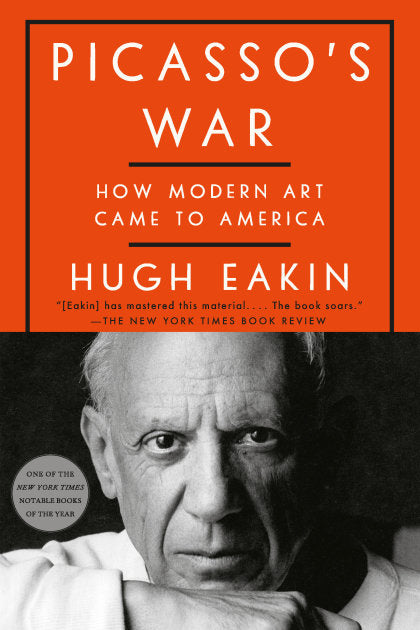
ABOUT
“[Eakin] has mastered this material. . . . The book soars.”—The New York Times Book Review (Editors’ Choice)
ONE OF THE BEST BOOKS OF THE YEAR: Vanity Fair, The New York Times Book Review, The New Yorker
In January 1939, Pablo Picasso was renowned in Europe but disdained by many in the United States. One year later, Americans across the country were clamoring to see his art. How did the controversial leader of the Paris avant-garde break through to the heart of American culture?
The answer begins a generation earlier, when a renegade Irish American lawyer named John Quinn set out to build the greatest collection of Picassos in existence. His dream of a museum to house them died with him, until it was rediscovered by Alfred H. Barr, Jr., a cultural visionary who, at the age of twenty-seven, became the director of New York’s new Museum of Modern Art.
Barr and Quinn’s shared goal would be thwarted in the years to come—by popular hostility, by the Depression, by Parisian intrigues, and by Picasso himself. It would take Hitler’s campaign against Jews and modern art, and Barr’s fraught alliance with Paul Rosenberg, Picasso’s persecuted dealer, to get Picasso’s most important paintings out of Europe. Mounted in the shadow of war, the groundbreaking exhibition Picasso: Forty Years of His Art would launch Picasso in America, define MoMA as we know it, and shift the focus of the art world from Paris to New York.
Picasso’s War is the never-before-told story about how a single exhibition, a decade in the making, irrevocably changed American taste, and in doing so saved dozens of the twentieth century’s most enduring artworks from the Nazis. Through a deft combination of new scholarship and vivid storytelling, Hugh Eakin shows how two men and their obsession with Picasso changed the art world forever.
STANDARD, PRIMARY, DM AND VARIANT COVERS
Standard and Primary covers are widely available through general retailers. They often have higher print runs and can be cheaper, especially during sales.
In contrast, Direct Market (DM) and variant covers are primarily sold in comic shops. DM editions tend to have more limited availability and may be more valuable to collectors.
The main differences lie in artwork style, availability, price, and collector appeal. Ultimately, the choice between standard and variant covers depends on personal preference, budget, and individual collecting goals.
PRODUCT TYPES
Comic book enthusiasts have various formats to choose from when collecting their favorite stories.
Here's a brief overview of the main types:
Omnibus
- Large, hardcover collections
- Usually contain complete runs or extensive story arcs
- Typically 800-1000+ pages
- Higher price point, often €100-€150
Oversized Hardcover (OHC)
- Similar dimensions to omnibus, but thinner
- Collect shorter runs or story arcs
- Usually 300-600 pages
- Priced between €30-€50
Hardcover (HC)
- Standard-sized hardcover books
- Collect 6-12 issues typically
- Similar dimensions to single issues, but with a hard cover
- Priced around €25-€35
Trade Paperback (TP)
- Softcover collections
- Standard comic book size
- Usually collect 4-6 issues
- Most affordable option, typically €15-€25
Other Formats
- Absolute Editions: Oversized, deluxe hardcovers (mainly DC Comics)
- Compendiums: Massive paperback collections
- Graphic Novels (OGN/GN): Original stories not previously released as single issues
The choice between these formats often depends on personal preference, budget, and collecting goals. Omnibus and OHC editions offer larger artwork and more content but at a higher price, while TPs provide a more affordable way to collect complete story arcs