

Clarkson Potter/Ten Speed
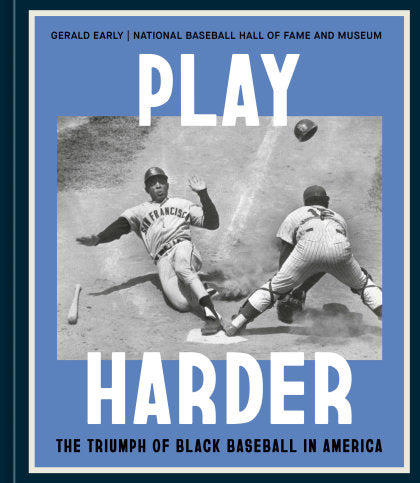
Play Harder
Play Harder
Couldn't load pickup availability
Collapsible content
ABOUT
FINALIST: CASEY AWARD FOR THE BEST BASEBALL BOOK OF THE YEAR
No sport has been more associated with America’s sense of itself, with its identity, than baseball. No sport has been so inextricably bound with America’s traditions—with its notions of democracy and fair play—than baseball. And no professional sport in America has been as dramatically connected to social change as Major League Baseball when it became racially integrated the moment Jackie Robinson took the field with the Brooklyn Dodgers on April 15, 1947.
Play Harder comes at a time when the history of Black baseball has become especially relevant—following MLB's recent recognition of the Negro Leagues as major leagues and the effort to incorporate statistics from the Negro Leagues into those for all players. Before Robinson, as Play Harder shows, Black athletes played baseball as far back as the 1800s even before the establishment of the Negro Leagues. But once founded in 1920, the Negro Leagues gave Black Americans an inroad to baseball that would be enduring and profound. The leagues were an instrument of community building during a time when discrimination separated Black people from all white enterprises, including baseball, and they paved the way for racial integration that Black players hoped would come.
Play Harder showcases the Black stars of the game—those from baseball’s early years such as Moses Fleetwood Walker and Rube Foster; Negro Leagues stars like Satchel Paige and Cool Papa Bell; Jackie Robinson and those who crossed the color line after him, like Hank Aaron and Willie Mays, followed by Frank Robinson and Curt Flood; and the stars who ushered in today’s game, such as Reggie Jackson, Dave Winfield, Barry Bonds, and Ken Griffey, Jr. Playing out against the cultural and political events of 150 years, the story bears witness to the richness of this country's diversity while remaining clear-eyed about the racial injustice endured by Black Americans. In the end, Play Harder celebrates the triumph of some of baseball’s greatest players and their remarkable contributions to the game we know and love today.
STANDARD, PRIMARY, DM AND VARIANT COVERS
Standard and Primary covers are widely available through general retailers. They often have higher print runs and can be cheaper, especially during sales.
In contrast, Direct Market (DM) and variant covers are primarily sold in comic shops. DM editions tend to have more limited availability and may be more valuable to collectors.
The main differences lie in artwork style, availability, price, and collector appeal. Ultimately, the choice between standard and variant covers depends on personal preference, budget, and individual collecting goals.
PRODUCT TYPES
Comic book enthusiasts have various formats to choose from when collecting their favorite stories.
Here's a brief overview of the main types:
Omnibus
- Large, hardcover collections
- Usually contain complete runs or extensive story arcs
- Typically 800-1000+ pages
- Higher price point, often €100-€150
Oversized Hardcover (OHC)
- Similar dimensions to omnibus, but thinner
- Collect shorter runs or story arcs
- Usually 300-600 pages
- Priced between €30-€50
Hardcover (HC)
- Standard-sized hardcover books
- Collect 6-12 issues typically
- Similar dimensions to single issues, but with a hard cover
- Priced around €25-€35
Trade Paperback (TP)
- Softcover collections
- Standard comic book size
- Usually collect 4-6 issues
- Most affordable option, typically €15-€25
Other Formats
- Absolute Editions: Oversized, deluxe hardcovers (mainly DC Comics)
- Compendiums: Massive paperback collections
- Graphic Novels (OGN/GN): Original stories not previously released as single issues
The choice between these formats often depends on personal preference, budget, and collecting goals. Omnibus and OHC editions offer larger artwork and more content but at a higher price, while TPs provide a more affordable way to collect complete story arcs