

Penguin Publishing Group
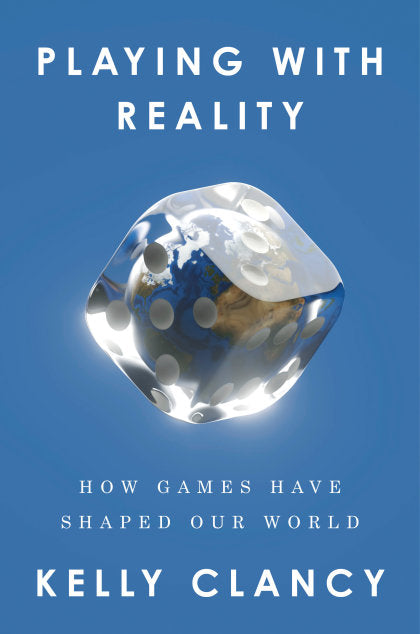
Playing with Reality
Playing with Reality
Couldn't load pickup availability
Collapsible content
ABOUT
“Absorbing. . . . A revealing look at the hidden role that games have played in human development for centuries.” —Kirkus
“By turns philosophical and polemical, this is a provocative and fascinating book.” —The Economist
A wide-ranging intellectual history that reveals how important games have been to human progress, and what’s at stake when we forget what games we’re really playing.
We play games to learn about the world, to understand our minds and the minds of others, and to make predictions about the future. Games are an essential aspect of humanity and a powerful tool for modeling reality. They’re also a lot of fun. But games can be dangerous, especially when we mistake the model worlds of games for reality itself and let gamification co-opt human decision making.
Playing with Reality explores the riveting history of games since the Enlightenment, weaving an unexpected path through military theory, political science, evolutionary biology, the development of computers and AI, cutting-edge neuroscience, and cognitive psychology. Neuroscientist and physicist Kelly Clancy shows how intertwined games have been with the arc of history. War games shaped the outcomes of real wars in nineteenth and twentieth century Europe. Game theory warped our understanding of human behavior and brought us to the brink of annihilation—yet still underlies basic assumptions in economics, politics, and technology design. We used games to teach computers how to learn for themselves, and now we are designing games that will determine the shape of society and future of democracy.
In this revelatory work, Clancy makes the bold argument that the human fascination with games is the key to understanding our nature and our actions.
STANDARD, PRIMARY, DM AND VARIANT COVERS
Standard and Primary covers are widely available through general retailers. They often have higher print runs and can be cheaper, especially during sales.
In contrast, Direct Market (DM) and variant covers are primarily sold in comic shops. DM editions tend to have more limited availability and may be more valuable to collectors.
The main differences lie in artwork style, availability, price, and collector appeal. Ultimately, the choice between standard and variant covers depends on personal preference, budget, and individual collecting goals.
PRODUCT TYPES
Comic book enthusiasts have various formats to choose from when collecting their favorite stories.
Here's a brief overview of the main types:
Omnibus
- Large, hardcover collections
- Usually contain complete runs or extensive story arcs
- Typically 800-1000+ pages
- Higher price point, often €100-€150
Oversized Hardcover (OHC)
- Similar dimensions to omnibus, but thinner
- Collect shorter runs or story arcs
- Usually 300-600 pages
- Priced between €30-€50
Hardcover (HC)
- Standard-sized hardcover books
- Collect 6-12 issues typically
- Similar dimensions to single issues, but with a hard cover
- Priced around €25-€35
Trade Paperback (TP)
- Softcover collections
- Standard comic book size
- Usually collect 4-6 issues
- Most affordable option, typically €15-€25
Other Formats
- Absolute Editions: Oversized, deluxe hardcovers (mainly DC Comics)
- Compendiums: Massive paperback collections
- Graphic Novels (OGN/GN): Original stories not previously released as single issues
The choice between these formats often depends on personal preference, budget, and collecting goals. Omnibus and OHC editions offer larger artwork and more content but at a higher price, while TPs provide a more affordable way to collect complete story arcs