

Random House Publishing Group
Playing with Trains
Playing with Trains
Couldn't load pickup availability
Collapsible content
ABOUT
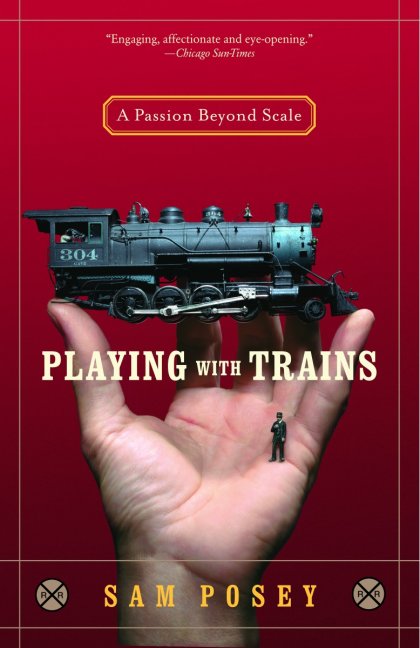
Posey’s first layout, wired by his mother in the years just after the Second World War, was, as he writes in his Introduction, “a miniature universe which I could operate on my own. Speed and control: I was fascinated by both, as well as by the way they were inextricably bound together.” Eventually, when Posey’s son was born, he was convinced that building him a basement layout would be the highest expression of fatherhood. Sixteen years and thousands of hours later, this project, “the outgrowth of chance meetings, unexpected friendships, mistakes, illness, latent ambitions, and sheer luck” was completed. But for Posey, the creation of his HO-scale masterpiece based on the historic Colorado Midland, was just the beginning.
In Playing with Trains, Sam Posey ventures well beyond the borders of his layout in northwestern Connecticut, to find out what makes the top modelers tick. He expects to find men “engaged in a genial hobby, happy to spend a few hours a week escaping the pressures of contemporary life.” Instead he uncovers a world of extremes–extreme commitment, extreme passion, and extreme differences of approach. For instance, Malcolm Furlow, holed up on his ranch in the wilderness of New Mexico, insists that model railroading is defined by scenery and artistic self-expression. On the other hand, Tony Koester, a New Jersey modeler, believes his “mission” is to replicate, with fanatical precision and authenticity, the way a real railroad operates. Going to extremes himself, Posey actually “test drives” a real steam engine in Strasburg, Pennsylvania, in an attempt to understand the great machines that inspired the models and connect us to a time when “the railroad was inventing America.” Timeless and original, Playing with Trains reveals a classic, questing American world.
STANDARD, PRIMARY, DM AND VARIANT COVERS
Standard and Primary covers are widely available through general retailers. They often have higher print runs and can be cheaper, especially during sales.
In contrast, Direct Market (DM) and variant covers are primarily sold in comic shops. DM editions tend to have more limited availability and may be more valuable to collectors.
The main differences lie in artwork style, availability, price, and collector appeal. Ultimately, the choice between standard and variant covers depends on personal preference, budget, and individual collecting goals.
PRODUCT TYPES
Comic book enthusiasts have various formats to choose from when collecting their favorite stories.
Here's a brief overview of the main types:
Omnibus
- Large, hardcover collections
- Usually contain complete runs or extensive story arcs
- Typically 800-1000+ pages
- Higher price point, often €100-€150
Oversized Hardcover (OHC)
- Similar dimensions to omnibus, but thinner
- Collect shorter runs or story arcs
- Usually 300-600 pages
- Priced between €30-€50
Hardcover (HC)
- Standard-sized hardcover books
- Collect 6-12 issues typically
- Similar dimensions to single issues, but with a hard cover
- Priced around €25-€35
Trade Paperback (TP)
- Softcover collections
- Standard comic book size
- Usually collect 4-6 issues
- Most affordable option, typically €15-€25
Other Formats
- Absolute Editions: Oversized, deluxe hardcovers (mainly DC Comics)
- Compendiums: Massive paperback collections
- Graphic Novels (OGN/GN): Original stories not previously released as single issues
The choice between these formats often depends on personal preference, budget, and collecting goals. Omnibus and OHC editions offer larger artwork and more content but at a higher price, while TPs provide a more affordable way to collect complete story arcs