

Penguin Publishing Group
Political Tribes
Political Tribes
Couldn't load pickup availability
Collapsible content
ABOUT
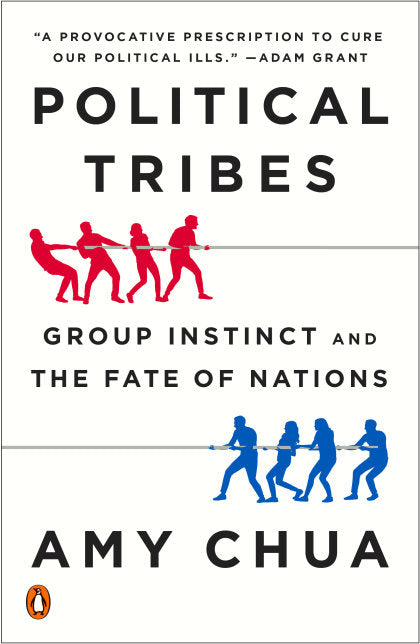
Humans are tribal. We need to belong to groups. In many parts of the world, the group identities that matter most – the ones that people will kill and die for – are ethnic, religious, sectarian, or clan-based. But because America tends to see the world in terms of nation-states engaged in great ideological battles – Capitalism vs. Communism, Democracy vs. Authoritarianism, the “Free World” vs. the “Axis of Evil” – we are often spectacularly blind to the power of tribal politics. Time and again this blindness has undermined American foreign policy.
In the Vietnam War, viewing the conflict through Cold War blinders, we never saw that most of Vietnam’s “capitalists” were members of the hated Chinese minority. Every pro-free-market move we made helped turn the Vietnamese people against us. In Iraq, we were stunningly dismissive of the hatred between that country’s Sunnis and Shias. If we want to get our foreign policy right – so as to not be perpetually caught off guard and fighting unwinnable wars – the United States has to come to grips with political tribalism abroad.
Just as Washington’s foreign policy establishment has been blind to the power of tribal politics outside the country, so too have American political elites been oblivious to the group identities that matter most to ordinary Americans – and that are tearing the United States apart. As the stunning rise of Donald Trump laid bare, identity politics have seized both the American left and right in an especially dangerous, racially inflected way. In America today, every group feels threatened: whites and blacks, Latinos and Asians, men and women, liberals and conservatives, and so on. There is a pervasive sense of collective persecution and discrimination. On the left, this has given rise to increasingly radical and exclusionary rhetoric of privilege and cultural appropriation. On the right, it has fueled a disturbing rise in xenophobia and white nationalism.
In characteristically persuasive style, Amy Chua argues that America must rediscover a national identity that transcends our political tribes. Enough false slogans of unity, which are just another form of divisiveness. It is time for a more difficult unity that acknowledges the reality of group differences and fights the deep inequities that divide us.
STANDARD, PRIMARY, DM AND VARIANT COVERS
Standard and Primary covers are widely available through general retailers. They often have higher print runs and can be cheaper, especially during sales.
In contrast, Direct Market (DM) and variant covers are primarily sold in comic shops. DM editions tend to have more limited availability and may be more valuable to collectors.
The main differences lie in artwork style, availability, price, and collector appeal. Ultimately, the choice between standard and variant covers depends on personal preference, budget, and individual collecting goals.
PRODUCT TYPES
Comic book enthusiasts have various formats to choose from when collecting their favorite stories.
Here's a brief overview of the main types:
Omnibus
- Large, hardcover collections
- Usually contain complete runs or extensive story arcs
- Typically 800-1000+ pages
- Higher price point, often €100-€150
Oversized Hardcover (OHC)
- Similar dimensions to omnibus, but thinner
- Collect shorter runs or story arcs
- Usually 300-600 pages
- Priced between €30-€50
Hardcover (HC)
- Standard-sized hardcover books
- Collect 6-12 issues typically
- Similar dimensions to single issues, but with a hard cover
- Priced around €25-€35
Trade Paperback (TP)
- Softcover collections
- Standard comic book size
- Usually collect 4-6 issues
- Most affordable option, typically €15-€25
Other Formats
- Absolute Editions: Oversized, deluxe hardcovers (mainly DC Comics)
- Compendiums: Massive paperback collections
- Graphic Novels (OGN/GN): Original stories not previously released as single issues
The choice between these formats often depends on personal preference, budget, and collecting goals. Omnibus and OHC editions offer larger artwork and more content but at a higher price, while TPs provide a more affordable way to collect complete story arcs