

Penguin Publishing Group
Popular
Popular
Couldn't load pickup availability
Collapsible content
ABOUT
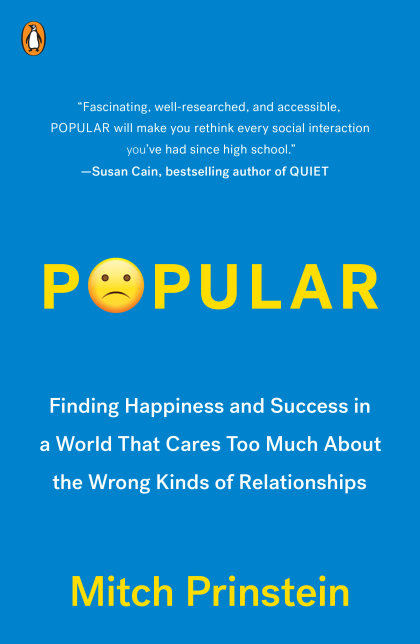
Popular examines why popularity plays such a key role in our development and, ultimately, how it still influences our happiness and success today. In many ways—some even beyond our conscious awareness—those old dynamics of our youth continue to play out in every business meeting, every social gathering, in our personal relationships, and even how we raise our children. Our popularity even affects our DNA, our health, and our mortality in fascinating ways we never previously realized. More than childhood intelligence, family background, or prior psychological issues, research indicates that it’s how popular we were in our early years that predicts how successful and how happy we grow up to be.
But it’s not always the conventionally popular people who fare the best, for the simple reason that there is more than one type of popularity—and many of us still long for the wrong one. As children, we strive to be likable, which can offer real benefits not only on the playground but throughout our lives. In adolescence, though, a new form of popularity emerges, and we suddenly begin to care about status, power, influence, and notoriety—research indicates that this type of popularity hurts us more than we realize.
Popular addresses a topic more relevant today than ever before. In a world that pushes us to pursue power, and click our way to online status, it has become too easy to be lured towards a type of popularity that can harm us, and our children. Popular relies on the latest research in psychology and neuroscience to help us make the wisest choices for ourselves and for our children. With specific tips for parents, business leaders, and all adults who can remember their high school experiences, as well as a letter to teens to help this generation navigate a world in which popularity has become more complex than ever before, Popular can teach us all how to achieve more meaningful, successful, and rewarding relationships.
STANDARD, PRIMARY, DM AND VARIANT COVERS
Standard and Primary covers are widely available through general retailers. They often have higher print runs and can be cheaper, especially during sales.
In contrast, Direct Market (DM) and variant covers are primarily sold in comic shops. DM editions tend to have more limited availability and may be more valuable to collectors.
The main differences lie in artwork style, availability, price, and collector appeal. Ultimately, the choice between standard and variant covers depends on personal preference, budget, and individual collecting goals.
PRODUCT TYPES
Comic book enthusiasts have various formats to choose from when collecting their favorite stories.
Here's a brief overview of the main types:
Omnibus
- Large, hardcover collections
- Usually contain complete runs or extensive story arcs
- Typically 800-1000+ pages
- Higher price point, often €100-€150
Oversized Hardcover (OHC)
- Similar dimensions to omnibus, but thinner
- Collect shorter runs or story arcs
- Usually 300-600 pages
- Priced between €30-€50
Hardcover (HC)
- Standard-sized hardcover books
- Collect 6-12 issues typically
- Similar dimensions to single issues, but with a hard cover
- Priced around €25-€35
Trade Paperback (TP)
- Softcover collections
- Standard comic book size
- Usually collect 4-6 issues
- Most affordable option, typically €15-€25
Other Formats
- Absolute Editions: Oversized, deluxe hardcovers (mainly DC Comics)
- Compendiums: Massive paperback collections
- Graphic Novels (OGN/GN): Original stories not previously released as single issues
The choice between these formats often depends on personal preference, budget, and collecting goals. Omnibus and OHC editions offer larger artwork and more content but at a higher price, while TPs provide a more affordable way to collect complete story arcs