

Knopf Doubleday Publishing Group
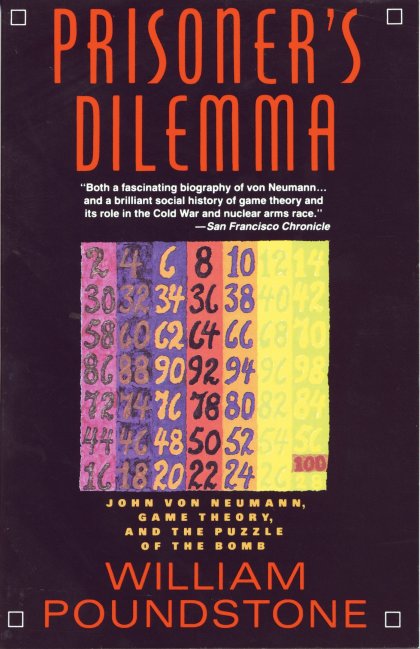
Prisoner's Dilemma
Prisoner's Dilemma
Couldn't load pickup availability
Collapsible content
ABOUT
Should you watch public television without pledging?...Exceed the posted speed limit?...Hop a subway turnstile without paying? These questions illustrate the so-called "prisoner's dilemma", a social puzzle that we all face every day. Though the answers may seem simple, their profound implications make the prisoner's dilemma one of the great unifying concepts of science. Watching players bluff in a poker game inspired John von Neumann—father of the modern computer and one of the sharpest minds of the century—to construct game theory, a mathematical study of conflict and deception. Game theory was readily embraced at the RAND Corporation, the archetypical think tank charged with formulating military strategy for the atomic age, and in 1950 two RAND scientists made a momentous discovery.
Called the "prisoner's dilemma," it is a disturbing and mind-bending game where two or more people may betray the common good for individual gain. Introduced shortly after the Soviet Union acquired the atomic bomb, the prisoner's dilemma quickly became a popular allegory of the nuclear arms race. Intellectuals such as von Neumann and Bertrand Russell joined military and political leaders in rallying to the "preventive war" movement, which advocated a nuclear first strike against the Soviet Union. Though the Truman administration rejected preventive war the United States entered into an arms race with the Soviets and game theory developed into a controversial tool of public policy—alternately accused of justifying arms races and touted as the only hope of preventing them.
Prisoner's Dilemma is the incisive story of a revolutionary idea that has been hailed as a landmark of twentieth-century thought.
STANDARD, PRIMARY, DM AND VARIANT COVERS
Standard and Primary covers are widely available through general retailers. They often have higher print runs and can be cheaper, especially during sales.
In contrast, Direct Market (DM) and variant covers are primarily sold in comic shops. DM editions tend to have more limited availability and may be more valuable to collectors.
The main differences lie in artwork style, availability, price, and collector appeal. Ultimately, the choice between standard and variant covers depends on personal preference, budget, and individual collecting goals.
PRODUCT TYPES
Comic book enthusiasts have various formats to choose from when collecting their favorite stories.
Here's a brief overview of the main types:
Omnibus
- Large, hardcover collections
- Usually contain complete runs or extensive story arcs
- Typically 800-1000+ pages
- Higher price point, often €100-€150
Oversized Hardcover (OHC)
- Similar dimensions to omnibus, but thinner
- Collect shorter runs or story arcs
- Usually 300-600 pages
- Priced between €30-€50
Hardcover (HC)
- Standard-sized hardcover books
- Collect 6-12 issues typically
- Similar dimensions to single issues, but with a hard cover
- Priced around €25-€35
Trade Paperback (TP)
- Softcover collections
- Standard comic book size
- Usually collect 4-6 issues
- Most affordable option, typically €15-€25
Other Formats
- Absolute Editions: Oversized, deluxe hardcovers (mainly DC Comics)
- Compendiums: Massive paperback collections
- Graphic Novels (OGN/GN): Original stories not previously released as single issues
The choice between these formats often depends on personal preference, budget, and collecting goals. Omnibus and OHC editions offer larger artwork and more content but at a higher price, while TPs provide a more affordable way to collect complete story arcs