

Random House Publishing Group
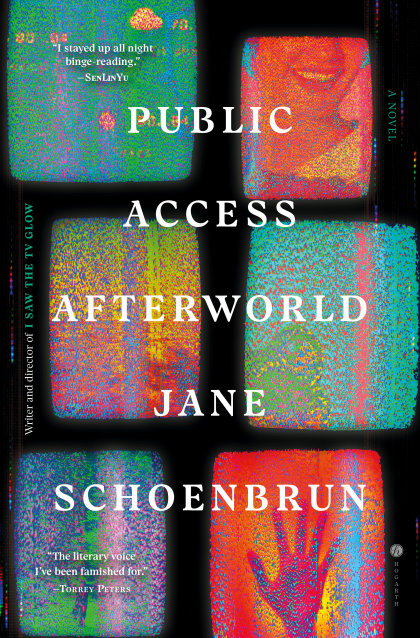
Public Access Afterworld
Public Access Afterworld
Couldn't load pickup availability
Collapsible content
ABOUT
“Beautiful, funny, and scathing . . . I stayed up all night binge-reading.”—SenLinYu
“Gave me a vertiginous thrill I haven’t encountered since David Mitchell.”—Torrey Peters
“Psychedelic horror of the first order.”—Grady Hendrix
“Heart-wrenching, hilarious, visionary, and so damned smart, this novel is a major work by a major writer.”—Paul Tremblay
“Utterly hypnotic.”—Lev Grossman
“Dazzling and politically acute, Schoenbrun’s debut announces a major literary voice.”—Kirkus Reviews (starred review)
“A dazzling story . . . a great American novel.”—Publishers Weekly (starred review)
One of Publishers Weekly’s 10 Most Anticipated Books • One of the Most Anticipated Books of the Year: The New York Times Book Review Podcast, The Boston Globe, Lit Hub, The Chicago Review of Books, The Bookseller, Reactor, Book Riot, Crime Reads, Library Journal, Kirkus Reviews, and Debutiful
Find the receiver. Make it real.
At 5:35 p.m. on September 3, 1988, Dallas weatherman Ray “Can You Say Sunshine” Davino makes passing reference to Public Access Afterworld during a rambling monologue, right before he puts a gun to his head on live television and pulls the trigger.
On June 12, 2009, David Sawyer and Erin Morrison, two lonely, TV-obsessed suburban teens who might be falling in love, gather in Erin's basement to watch TV's analog-to-digital transition. But in the static that follows, Erin witnesses surreal broadcasts from a pirate TV network called Public Access Afterworld, and their lives are changed forever.
Seventeen years later, Bethany Peters toils through the night shift at megacorp GlobalVill’s bleak Austin campus. A trans content moderator, she spends her evenings reviewing an endless stream of horrific videos. But then a young streamer begins to crop up in her feed calling out to Public Access Afterworld.
But what is Public Access Afterworld?
Spanning decades and realities, with an unforgettable ensemble of outcasts and nerds—especially the messy but wholly relatable Bethany, who must overcome paranoia and self-doubt to transform into a hero of our times—Public Access Afterworld will have you reading through the night and rooting for its characters to survive. A mesmerizing mash-up of speculative fiction, horror, and conspiracy, it marks the arrival of a major new force in contemporary fiction by a groundbreaking filmmaker who’s been compared to David Lynch and Paul Thomas Anderson.
STANDARD, PRIMARY, DM AND VARIANT COVERS
Standard and Primary covers are widely available through general retailers. They often have higher print runs and can be cheaper, especially during sales.
In contrast, Direct Market (DM) and variant covers are primarily sold in comic shops. DM editions tend to have more limited availability and may be more valuable to collectors.
The main differences lie in artwork style, availability, price, and collector appeal. Ultimately, the choice between standard and variant covers depends on personal preference, budget, and individual collecting goals.
PRODUCT TYPES
Comic book enthusiasts have various formats to choose from when collecting their favorite stories.
Here's a brief overview of the main types:
Omnibus
- Large, hardcover collections
- Usually contain complete runs or extensive story arcs
- Typically 800-1000+ pages
- Higher price point, often €100-€150
Oversized Hardcover (OHC)
- Similar dimensions to omnibus, but thinner
- Collect shorter runs or story arcs
- Usually 300-600 pages
- Priced between €30-€50
Hardcover (HC)
- Standard-sized hardcover books
- Collect 6-12 issues typically
- Similar dimensions to single issues, but with a hard cover
- Priced around €25-€35
Trade Paperback (TP)
- Softcover collections
- Standard comic book size
- Usually collect 4-6 issues
- Most affordable option, typically €15-€25
Other Formats
- Absolute Editions: Oversized, deluxe hardcovers (mainly DC Comics)
- Compendiums: Massive paperback collections
- Graphic Novels (OGN/GN): Original stories not previously released as single issues
The choice between these formats often depends on personal preference, budget, and collecting goals. Omnibus and OHC editions offer larger artwork and more content but at a higher price, while TPs provide a more affordable way to collect complete story arcs