

Random House Publishing Group
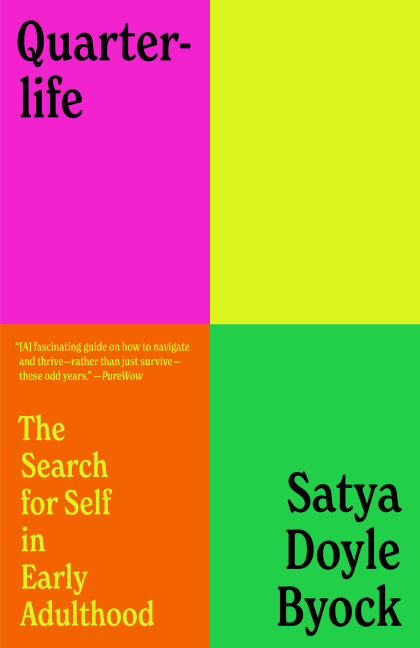
Quarterlife
Quarterlife
Couldn't load pickup availability
Collapsible content
ABOUT
“Quarterlife is an insightful, revealing look at the messy and uncharted paths to wholeness, and a powerful tool for anyone navigating early adulthood.”—Tembi Locke, New York Times bestselling author of From Scratch
I’m stuck. What’s wrong with me? Is this all there is? Satya Doyle Byock hears these refrains regularly in her psychotherapy practice where she works with “Quarterlifers,” individuals between the ages of (roughly) sixteen to thirty-six. She understands their frustration. Some clients have done everything “right”: graduate, get a job, meet a partner. Yet they are unfulfilled and unclear on what to do next. Byock calls these Quarterlifers “Stability Types.” Others are uninterested in this prescribed path, but feel unmoored. She refers to them as “Meaning Types.”
While society is quick to label the emotions and behavior of this age group as generational traits, Byock sees things differently. She believes these struggles are part of the developmental journey of Quarterlife, a distinct stage that every person goes through and which has been virtually ignored by popular culture and psychology.
In Quarterlife, Byock utilizes personal storytelling, mythology, Jungian psychology, pop culture, literature, and client case studies to provide guideposts for this period of life. Readers will be able to find themselves on the spectrum between Stability and Meaning Types, and engage with Byock’s four pillars of Quarterlife development:
• Separate: Gain independence from the relationships and expectations that no longer serve you
• Listen: Pay close attention to your own wants and needs
• Build: Create, cultivate, and construct tools and practices for the life you want
• Integrate: Take what you’ve learned and manifest something new
Quarterlife is a defining work that offers a compassionate roadmap toward finding understanding, happiness, and wholeness in adulthood.
STANDARD, PRIMARY, DM AND VARIANT COVERS
Standard and Primary covers are widely available through general retailers. They often have higher print runs and can be cheaper, especially during sales.
In contrast, Direct Market (DM) and variant covers are primarily sold in comic shops. DM editions tend to have more limited availability and may be more valuable to collectors.
The main differences lie in artwork style, availability, price, and collector appeal. Ultimately, the choice between standard and variant covers depends on personal preference, budget, and individual collecting goals.
PRODUCT TYPES
Comic book enthusiasts have various formats to choose from when collecting their favorite stories.
Here's a brief overview of the main types:
Omnibus
- Large, hardcover collections
- Usually contain complete runs or extensive story arcs
- Typically 800-1000+ pages
- Higher price point, often €100-€150
Oversized Hardcover (OHC)
- Similar dimensions to omnibus, but thinner
- Collect shorter runs or story arcs
- Usually 300-600 pages
- Priced between €30-€50
Hardcover (HC)
- Standard-sized hardcover books
- Collect 6-12 issues typically
- Similar dimensions to single issues, but with a hard cover
- Priced around €25-€35
Trade Paperback (TP)
- Softcover collections
- Standard comic book size
- Usually collect 4-6 issues
- Most affordable option, typically €15-€25
Other Formats
- Absolute Editions: Oversized, deluxe hardcovers (mainly DC Comics)
- Compendiums: Massive paperback collections
- Graphic Novels (OGN/GN): Original stories not previously released as single issues
The choice between these formats often depends on personal preference, budget, and collecting goals. Omnibus and OHC editions offer larger artwork and more content but at a higher price, while TPs provide a more affordable way to collect complete story arcs