

Penguin Publishing Group
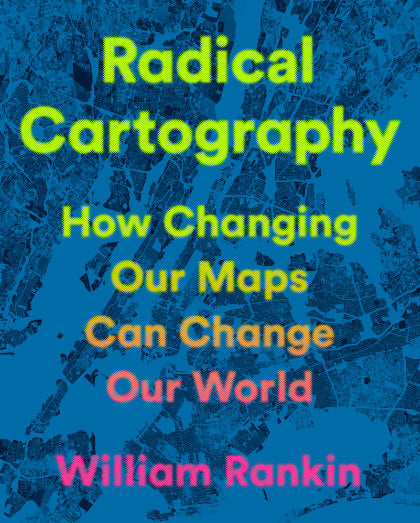
Radical Cartography
Radical Cartography
Couldn't load pickup availability
Collapsible content
ABOUT
A stunning, thought-provoking exploration of how maps shape our understanding of the world—featuring over 150 full-color maps in a gorgeous package
Maps are ubiquitous in contemporary life—not just for navigation, but for making sense of our society, our environment, and even ourselves. In an instant, huge datasets can be plotted on command and we can explore faraway places in exacting detail. Yet the new ease and speed of data mapping can often lead to the same results as ever: over-simplified maps used as tools for top-down control.
Cartographer and historian William Rankin argues that it’s time to reimagine what a map can be and how it can be used. Maps are not neutral visualizations of facts. They are innately political, defining how the world is divided, what becomes visible and what stays hidden, and whose voices are heard. What matters isn’t just the topics or the data, but how maps make arguments about how the world works. And the consequences are enormous. A map’s visual argument can change how cities are designed and how rivers flow, how wars are fought and how land claims are settled, how children learn about race and how colonialism becomes a habit of mind. Maps don’t just show us information—they help construct our world.
Brimming with vibrant maps, including many “radical” maps created by Rankin himself and by other cutting-edge mapmakers, Radical Cartography exposes the consequences of how maps represent boundaries, layers, people, projections, color, scale, and time. Challenging the map as a tool of the status quo, Rankin empowers readers to embrace three unexpected values for the future of cartography: uncertainty, multiplicity, and subjectivity. Changing the tools—changing the maps—can change the questions we ask, the answers we accept, and the world we build.
STANDARD, PRIMARY, DM AND VARIANT COVERS
Standard and Primary covers are widely available through general retailers. They often have higher print runs and can be cheaper, especially during sales.
In contrast, Direct Market (DM) and variant covers are primarily sold in comic shops. DM editions tend to have more limited availability and may be more valuable to collectors.
The main differences lie in artwork style, availability, price, and collector appeal. Ultimately, the choice between standard and variant covers depends on personal preference, budget, and individual collecting goals.
PRODUCT TYPES
Comic book enthusiasts have various formats to choose from when collecting their favorite stories.
Here's a brief overview of the main types:
Omnibus
- Large, hardcover collections
- Usually contain complete runs or extensive story arcs
- Typically 800-1000+ pages
- Higher price point, often €100-€150
Oversized Hardcover (OHC)
- Similar dimensions to omnibus, but thinner
- Collect shorter runs or story arcs
- Usually 300-600 pages
- Priced between €30-€50
Hardcover (HC)
- Standard-sized hardcover books
- Collect 6-12 issues typically
- Similar dimensions to single issues, but with a hard cover
- Priced around €25-€35
Trade Paperback (TP)
- Softcover collections
- Standard comic book size
- Usually collect 4-6 issues
- Most affordable option, typically €15-€25
Other Formats
- Absolute Editions: Oversized, deluxe hardcovers (mainly DC Comics)
- Compendiums: Massive paperback collections
- Graphic Novels (OGN/GN): Original stories not previously released as single issues
The choice between these formats often depends on personal preference, budget, and collecting goals. Omnibus and OHC editions offer larger artwork and more content but at a higher price, while TPs provide a more affordable way to collect complete story arcs