

Knopf Doubleday Publishing Group
Reading Lyrics
Reading Lyrics
Couldn't load pickup availability
Collapsible content
ABOUT
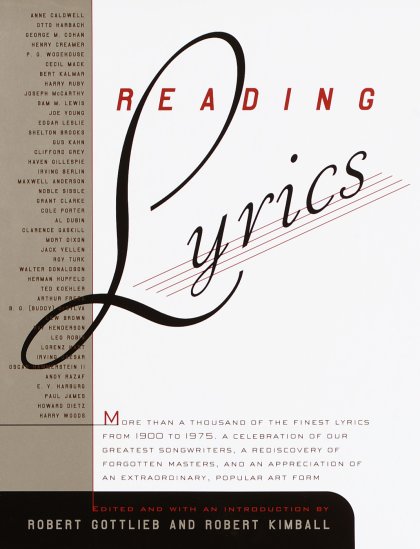
Reading Lyrics begins with the first masters of the colloquial phrase, including George M. Cohan (“Give My Regards to Broadway”), P. G. Wodehouse (“Till the Clouds Roll By”), and Irving Berlin, whose versatility and career span the period from “Alexander’s Ragtime Band” to “Annie Get Your Gun” and beyond. The Broadway musical emerges as a distinct dramatic form in the 1920s and 1930s, its evolution propelled by a trio of lyricists—Cole Porter, Ira Gershwin, and Lorenz Hart—whose explorations of the psychological and emotional nuances of falling in and out of love have lost none of their wit and sophistication. Their songs, including “Night and Day,” “The Man I Love,” and “Bewitched, Bothered and Bewildered,” have become standards performed and recorded by generation after generation of singers. The lure of Broadway and Hollywood and the performing genius of such artists as Al Jolson, Fred Astaire, Ethel Waters, Judy Garland, Frank Sinatra, and Ethel Merman inspired a remarkable array of talented writers, including Dorothy Fields (“A Fine Romance,” “I Can’t Give You Anything but Love”), Frank Loesser (“Guys and Dolls”), Oscar Hammerstein II (from the groundbreaking “Show Boat” of 1927 through his extraordinary collaboration with Richard Rodgers), Johnny Mercer, Yip Harburg, Andy Razaf, Noël Coward, and Stephen Sondheim.
Reading Lyrics also celebrates the work of dozens of superb craftsmen whose songs remain known, but who today are themselves less known—writers like Haven Gillespie (whose “Santa Claus Is Coming to Town” may be the most widely recorded song of its era); Herman Hupfeld (not only the composer/lyricist of “As Time Goes By” but also of “Are You Makin’ Any Money?” and “When Yuba Plays the Rumba on the Tuba”); the great light versifier Ogden Nash (“Speak Low,” “I’m a Stranger Here Myself,” and, yes, “The Sea-Gull and the Ea-Gull”); Don Raye (“Boogie Woogie Bugle Boy,” “Mister Five by Five,” and, of course, “Milkman, Keep Those Bottles Quiet”); Bobby Troup (“Route 66”); Billy Strayhorn (not only for the omnipresent “Lush Life” but for “Something to Live For” and “A Lonely Coed”); Peggy Lee (not only a superb singer but also an original and appealing lyricist); and the unique Dave Frishberg (“I’m Hip,” “Peel Me a Grape,” “Van Lingo Mungo”).
The lyricists are presented chronologically, each introduced by a succinct biography and the incisive commentary of Robert Gottlieb and Robert Kimball.
STANDARD, PRIMARY, DM AND VARIANT COVERS
Standard and Primary covers are widely available through general retailers. They often have higher print runs and can be cheaper, especially during sales.
In contrast, Direct Market (DM) and variant covers are primarily sold in comic shops. DM editions tend to have more limited availability and may be more valuable to collectors.
The main differences lie in artwork style, availability, price, and collector appeal. Ultimately, the choice between standard and variant covers depends on personal preference, budget, and individual collecting goals.
PRODUCT TYPES
Comic book enthusiasts have various formats to choose from when collecting their favorite stories.
Here's a brief overview of the main types:
Omnibus
- Large, hardcover collections
- Usually contain complete runs or extensive story arcs
- Typically 800-1000+ pages
- Higher price point, often €100-€150
Oversized Hardcover (OHC)
- Similar dimensions to omnibus, but thinner
- Collect shorter runs or story arcs
- Usually 300-600 pages
- Priced between €30-€50
Hardcover (HC)
- Standard-sized hardcover books
- Collect 6-12 issues typically
- Similar dimensions to single issues, but with a hard cover
- Priced around €25-€35
Trade Paperback (TP)
- Softcover collections
- Standard comic book size
- Usually collect 4-6 issues
- Most affordable option, typically €15-€25
Other Formats
- Absolute Editions: Oversized, deluxe hardcovers (mainly DC Comics)
- Compendiums: Massive paperback collections
- Graphic Novels (OGN/GN): Original stories not previously released as single issues
The choice between these formats often depends on personal preference, budget, and collecting goals. Omnibus and OHC editions offer larger artwork and more content but at a higher price, while TPs provide a more affordable way to collect complete story arcs