

Random House Publishing Group
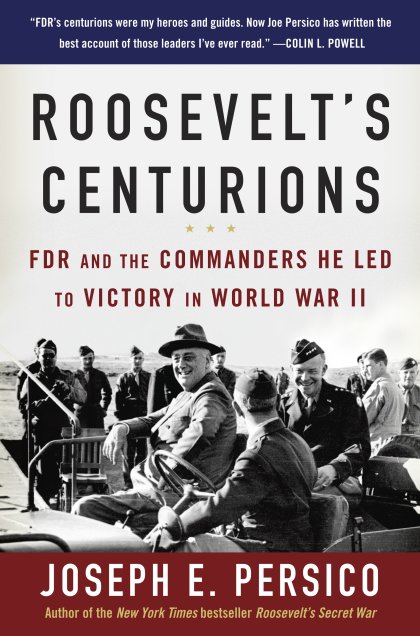
Roosevelt's Centurions
Roosevelt's Centurions
Couldn't load pickup availability
Collapsible content
ABOUT
All American presidents are commanders in chief by law. Few perform as such in practice. In Roosevelt’s Centurions, distinguished historian Joseph E. Persico reveals how, during World War II, Franklin D. Roosevelt seized the levers of wartime power like no president since Abraham Lincoln during the Civil War. Declaring himself “Dr. Win-the-War,” FDR assumed the role of strategist in chief, and, though surrounded by star-studded generals and admirals, he made clear who was running the war. FDR was a hands-on war leader, involving himself in everything from choosing bomber targets to planning naval convoys to the design of landing craft. Persico explores whether his strategic decisions, including his insistence on the Axis powers’ unconditional surrender, helped end or may have prolonged the war.
Taking us inside the Allied war councils, the author reveals how the president brokered strategy with contentious allies, particularly the iron-willed Winston Churchill; rallied morale on the home front; and handpicked a team of proud, sometimes prickly warriors who, he believed, could fight a global war. Persico’s history offers indelible portraits of the outsize figures who roused the “sleeping giant” that defeated the Axis war machine: the dutiful yet independent-minded George C. Marshall, charged with rebuilding an army whose troops trained with broomsticks for rifles, eggs for hand grenades; Dwight Eisenhower, an unassuming Kansan elevated from obscurity to command of the greatest fighting force ever assembled; the vainglorious Douglas MacArthur; and the bizarre battlefield genius George S. Patton. Here too are less widely celebrated military leaders whose contributions were just as critical: the irascible, dictatorial navy chief, Ernest King; the acerbic army advisor in China, “Vinegar” Joe Stilwell; and Henry H. “Hap” Arnold, who zealously preached the gospel of modern air power. The Roosevelt who emerges from these pages is a wartime chess master guiding America’s armed forces to a victory that was anything but foreordained.
What are the qualities we look for in a commander in chief? In an era of renewed conflict, when Americans are again confronting the questions that FDR faced—about the nature and exercise of global power—Roosevelt’s Centurions is a timely and revealing examination of what it takes to be a wartime leader in a freewheeling, complicated, and tumultuous democracy.
STANDARD, PRIMARY, DM AND VARIANT COVERS
Standard and Primary covers are widely available through general retailers. They often have higher print runs and can be cheaper, especially during sales.
In contrast, Direct Market (DM) and variant covers are primarily sold in comic shops. DM editions tend to have more limited availability and may be more valuable to collectors.
The main differences lie in artwork style, availability, price, and collector appeal. Ultimately, the choice between standard and variant covers depends on personal preference, budget, and individual collecting goals.
PRODUCT TYPES
Comic book enthusiasts have various formats to choose from when collecting their favorite stories.
Here's a brief overview of the main types:
Omnibus
- Large, hardcover collections
- Usually contain complete runs or extensive story arcs
- Typically 800-1000+ pages
- Higher price point, often €100-€150
Oversized Hardcover (OHC)
- Similar dimensions to omnibus, but thinner
- Collect shorter runs or story arcs
- Usually 300-600 pages
- Priced between €30-€50
Hardcover (HC)
- Standard-sized hardcover books
- Collect 6-12 issues typically
- Similar dimensions to single issues, but with a hard cover
- Priced around €25-€35
Trade Paperback (TP)
- Softcover collections
- Standard comic book size
- Usually collect 4-6 issues
- Most affordable option, typically €15-€25
Other Formats
- Absolute Editions: Oversized, deluxe hardcovers (mainly DC Comics)
- Compendiums: Massive paperback collections
- Graphic Novels (OGN/GN): Original stories not previously released as single issues
The choice between these formats often depends on personal preference, budget, and collecting goals. Omnibus and OHC editions offer larger artwork and more content but at a higher price, while TPs provide a more affordable way to collect complete story arcs