

Random House Publishing Group
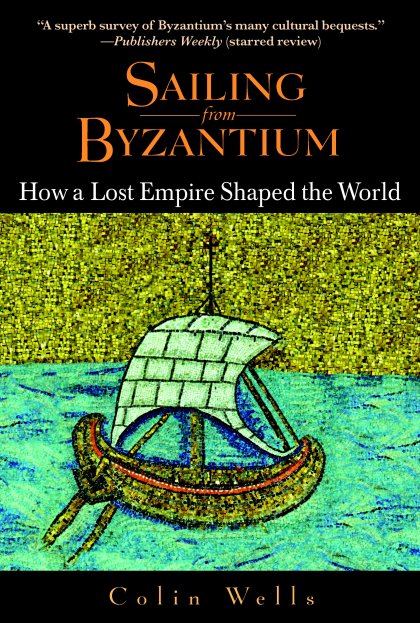
Sailing from Byzantium
Sailing from Byzantium
Couldn't load pickup availability
Collapsible content
ABOUT
Byzantium: the successor of Greece and Rome, this magnificent empire bridged the ancient and modern worlds for more than a thousand years. Without Byzantium, the works of Homer and Herodotus, Plato and Aristotle, Sophocles and Aeschylus, would never have survived. Yet very few of us have any idea of the enormous debt we owe them.
The story of Byzantium is a real-life adventure of electrifying ideas, high drama, colorful characters, and inspiring feats of daring. In Sailing from Byzantium, Colin Wells tells of the missionaries, mystics, philosophers, and artists who against great odds and often at peril of their own lives spread Greek ideas to the Italians, the Arabs, and the Slavs.
Their heroic efforts inspired the Renaissance, the golden age of Islamic learning, and Russian Orthodox Christianity, which came complete with a new alphabet, architecture, and one of the world’s greatest artistic traditions.
The story’s central reference point is an arcane squabble called the Hesychast controversy that pitted humanist scholars led by the brilliant, acerbic intellectual Barlaam against the powerful monks of Mount Athos led by the stern Gregory Palamas, who denounced “pagan” rationalism in favor of Christian mysticism.
Within a few decades, the light of Byzantium would be extinguished forever by the invading Turks, but not before the humanists found a safe haven for Greek literature. The controversy of rationalism versus faith would continue to be argued by some of history’s greatest minds.
Fast-paced, compulsively readable, and filled with fascinating insights, Sailing from Byzantium is one of the great historical dramas–the gripping story of how the flame of civilization was saved and passed on.
STANDARD, PRIMARY, DM AND VARIANT COVERS
Standard and Primary covers are widely available through general retailers. They often have higher print runs and can be cheaper, especially during sales.
In contrast, Direct Market (DM) and variant covers are primarily sold in comic shops. DM editions tend to have more limited availability and may be more valuable to collectors.
The main differences lie in artwork style, availability, price, and collector appeal. Ultimately, the choice between standard and variant covers depends on personal preference, budget, and individual collecting goals.
PRODUCT TYPES
Comic book enthusiasts have various formats to choose from when collecting their favorite stories.
Here's a brief overview of the main types:
Omnibus
- Large, hardcover collections
- Usually contain complete runs or extensive story arcs
- Typically 800-1000+ pages
- Higher price point, often €100-€150
Oversized Hardcover (OHC)
- Similar dimensions to omnibus, but thinner
- Collect shorter runs or story arcs
- Usually 300-600 pages
- Priced between €30-€50
Hardcover (HC)
- Standard-sized hardcover books
- Collect 6-12 issues typically
- Similar dimensions to single issues, but with a hard cover
- Priced around €25-€35
Trade Paperback (TP)
- Softcover collections
- Standard comic book size
- Usually collect 4-6 issues
- Most affordable option, typically €15-€25
Other Formats
- Absolute Editions: Oversized, deluxe hardcovers (mainly DC Comics)
- Compendiums: Massive paperback collections
- Graphic Novels (OGN/GN): Original stories not previously released as single issues
The choice between these formats often depends on personal preference, budget, and collecting goals. Omnibus and OHC editions offer larger artwork and more content but at a higher price, while TPs provide a more affordable way to collect complete story arcs