

Random House Publishing Group
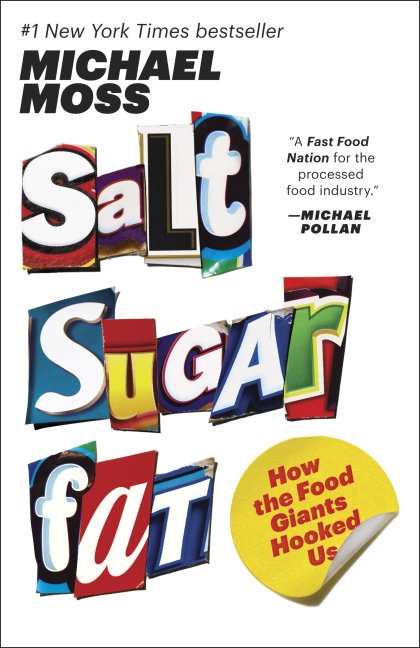
Salt Sugar Fat
Salt Sugar Fat
Couldn't load pickup availability
Collapsible content
ABOUT
#1 NEW YORK TIMES BESTSELLER • JAMES BEARD AWARD WINNER • In this “propulsively written [and] persuasively argued” (The Boston Globe) exposé, a Pulitzer Prize–winning investigative reporter uncovers an insidious truth: food companies are deliberately sacrificing our health to raise their own profits.
Thirty-eight million Americans have diabetes. One in three adults and one in five kids is clinically obese. Why?
Every year, the average American eats thirty-three pounds of cheese and seventy pounds of sugar. Every day, we ingest 8,500 milligrams of salt, double the recommended amount, almost none of which comes from the shakers on our table. It comes from processed food, an industry that hauls in $2 trillion in annual sales.
In Salt Sugar Fat, Michael Moss shows how we ended up here. Featuring examples from Kraft, Coca-Cola, Lunchables, Frito-Lay, Nestlé, Oreos, Capri Sun, and many more, Moss’s explosive, empowering narrative is grounded in meticulous, eye-opening research. He takes us into labs where scientists calculate the “bliss point” of sugary beverages or enhance the “mouthfeel” of fat by manipulating its chemical structure, unearths marketing techniques taken straight from tobacco company playbooks, and talks to concerned insiders who make startling confessions.
Just as millions of “heavy users” are addicted to salt, sugar, and fat, so too are the companies that peddle them. You will never look at a nutrition label the same way again.
A BEST BOOK OF THE YEAR: The Atlantic, HuffPost, Men’s Journal, MSN, Kirkus Reviews, Publishers Weekly
STANDARD, PRIMARY, DM AND VARIANT COVERS
Standard and Primary covers are widely available through general retailers. They often have higher print runs and can be cheaper, especially during sales.
In contrast, Direct Market (DM) and variant covers are primarily sold in comic shops. DM editions tend to have more limited availability and may be more valuable to collectors.
The main differences lie in artwork style, availability, price, and collector appeal. Ultimately, the choice between standard and variant covers depends on personal preference, budget, and individual collecting goals.
PRODUCT TYPES
Comic book enthusiasts have various formats to choose from when collecting their favorite stories.
Here's a brief overview of the main types:
Omnibus
- Large, hardcover collections
- Usually contain complete runs or extensive story arcs
- Typically 800-1000+ pages
- Higher price point, often €100-€150
Oversized Hardcover (OHC)
- Similar dimensions to omnibus, but thinner
- Collect shorter runs or story arcs
- Usually 300-600 pages
- Priced between €30-€50
Hardcover (HC)
- Standard-sized hardcover books
- Collect 6-12 issues typically
- Similar dimensions to single issues, but with a hard cover
- Priced around €25-€35
Trade Paperback (TP)
- Softcover collections
- Standard comic book size
- Usually collect 4-6 issues
- Most affordable option, typically €15-€25
Other Formats
- Absolute Editions: Oversized, deluxe hardcovers (mainly DC Comics)
- Compendiums: Massive paperback collections
- Graphic Novels (OGN/GN): Original stories not previously released as single issues
The choice between these formats often depends on personal preference, budget, and collecting goals. Omnibus and OHC editions offer larger artwork and more content but at a higher price, while TPs provide a more affordable way to collect complete story arcs