

Random House Publishing Group
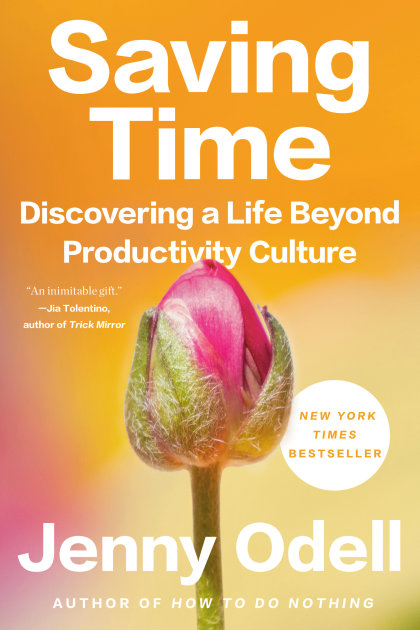
Saving Time
Saving Time
Couldn't load pickup availability
Collapsible content
ABOUT
“One of the most important books I’ve read in my life.”—Ed Yong, author of An Immense World
A BEST BOOK OF THE YEAR: Harper’s Bazaar, Esquire, Chicago Public Library, Electric Lit
In her first book, How to Do Nothing, Jenny Odell wrote about the importance of disconnecting from the “attention economy” to spend time in quiet contemplation. But how can we reclaim our time?
In order to answer this seemingly simple question, Odell took a deep dive into the fundamental structure of our society and found that the clock we live by was built for profit, not people. This is why our lives, even in leisure, have come to seem like a series of moments to be bought, sold, and processed ever more efficiently. Odell shows us how our painful relationship to time is inextricably connected not only to persisting social inequities but to the climate crisis, existential dread, and a lethal fatalism.
This dazzling, subversive, and deeply hopeful book offers us different ways to experience time—inspired by pre-industrial cultures, ecological cues, and geological timescales—that can bring within reach a more humane, responsive way of living. As planet-bound animals, we live inside shortening and lengthening days alongside gardens growing, birds migrating, and cliffs eroding; the stretchy quality of waiting and desire; the way the present may suddenly feel marbled with childhood memory; the slow but sure procession of a pregnancy; the time it takes to heal from injuries. Odell urges us to become stewards of these different rhythms of life in which time is not reducible to standardized units and instead forms the very medium of possibility.
Saving Time tugs at the seams of reality as we know it—the way we experience time itself—and rearranges it, imagining a world not centered on work, the office clock, or the profit motive. If we can “save” time by imagining a life, identity, and source of meaning outside these things, time might also save us.
STANDARD, PRIMARY, DM AND VARIANT COVERS
Standard and Primary covers are widely available through general retailers. They often have higher print runs and can be cheaper, especially during sales.
In contrast, Direct Market (DM) and variant covers are primarily sold in comic shops. DM editions tend to have more limited availability and may be more valuable to collectors.
The main differences lie in artwork style, availability, price, and collector appeal. Ultimately, the choice between standard and variant covers depends on personal preference, budget, and individual collecting goals.
PRODUCT TYPES
Comic book enthusiasts have various formats to choose from when collecting their favorite stories.
Here's a brief overview of the main types:
Omnibus
- Large, hardcover collections
- Usually contain complete runs or extensive story arcs
- Typically 800-1000+ pages
- Higher price point, often €100-€150
Oversized Hardcover (OHC)
- Similar dimensions to omnibus, but thinner
- Collect shorter runs or story arcs
- Usually 300-600 pages
- Priced between €30-€50
Hardcover (HC)
- Standard-sized hardcover books
- Collect 6-12 issues typically
- Similar dimensions to single issues, but with a hard cover
- Priced around €25-€35
Trade Paperback (TP)
- Softcover collections
- Standard comic book size
- Usually collect 4-6 issues
- Most affordable option, typically €15-€25
Other Formats
- Absolute Editions: Oversized, deluxe hardcovers (mainly DC Comics)
- Compendiums: Massive paperback collections
- Graphic Novels (OGN/GN): Original stories not previously released as single issues
The choice between these formats often depends on personal preference, budget, and collecting goals. Omnibus and OHC editions offer larger artwork and more content but at a higher price, while TPs provide a more affordable way to collect complete story arcs