

Harmony/Rodale/Convergent
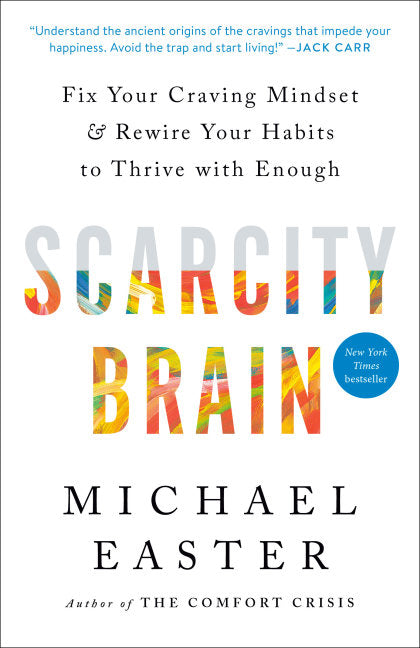
Scarcity Brain
Scarcity Brain
Couldn't load pickup availability
Collapsible content
ABOUT
“Reveals the biological and evolutionary foundations behind your brain’s fixations, so you can stop seeking and start living.”—Melissa Urban, Whole30 CEO and author of The Book of Boundaries
Have you ever found yourself wondering “Why do I want more than I have?” Michael Easter, author of The Comfort Crisis and one of the world’s leading experts on behavior change, shows that the problem isn’t you. The problem is your scarcity mindset, left over from our ancient ancestors. They had to constantly seek and consume to survive because vital survival tools like food, material goods, information, and power were scarce and hard to find.
But with our modern ability to easily fulfill our ancient desire for more, our hardwired “scarcity brain” is now backfiring. And new technology and institutions—from dating and entertainment apps to our food and economic systems—are exploiting our scarcity brain. They’re bombarding us with subversive “scarcity cues,” subtle triggers that lead us into low-reward cravings that hurt us in the long run. Scarcity cues can be direct and all-encompassing, like a sagging economy. Or they can be subtle and slight, like our neighbor buying a shiny new car.
Easter traveled the world to consult with remarkable innovators and leading scientists who are finding surprising solutions for our scarcity brain. He discovered simple tactics that can move us towards an abundance mindset, cement healthy habits, and allow us to live our lives to the fullest and appreciate what we have, including how to:
• Detect hidden scarcity cues to stop cravings before they start, from a brilliant slot machine designer in a Las Vegas casino laboratory
• Turn alone time into the ultimate happiness hack, from artisanal coffee-making Benedictine monks
• Reignite your exploration gene for a more exciting and fulfilling life, from an astronaut onboard the International Space Station
• Reframe how we think about and fix addiction and bad habits, from Iraq’s chief psychiatrist
• Recognize when you have enough, from a woman who left a million-dollar career path to adventure the world
Our world is overloaded with everything we’re built to crave. The fix for scarcity brain isn’t to blindly aim for less. It’s to understand why we crave more in the first place, shake our worst habits, and use what we already have better. Then we can experience life in a new way—a more satisfying way.
STANDARD, PRIMARY, DM AND VARIANT COVERS
Standard and Primary covers are widely available through general retailers. They often have higher print runs and can be cheaper, especially during sales.
In contrast, Direct Market (DM) and variant covers are primarily sold in comic shops. DM editions tend to have more limited availability and may be more valuable to collectors.
The main differences lie in artwork style, availability, price, and collector appeal. Ultimately, the choice between standard and variant covers depends on personal preference, budget, and individual collecting goals.
PRODUCT TYPES
Comic book enthusiasts have various formats to choose from when collecting their favorite stories.
Here's a brief overview of the main types:
Omnibus
- Large, hardcover collections
- Usually contain complete runs or extensive story arcs
- Typically 800-1000+ pages
- Higher price point, often €100-€150
Oversized Hardcover (OHC)
- Similar dimensions to omnibus, but thinner
- Collect shorter runs or story arcs
- Usually 300-600 pages
- Priced between €30-€50
Hardcover (HC)
- Standard-sized hardcover books
- Collect 6-12 issues typically
- Similar dimensions to single issues, but with a hard cover
- Priced around €25-€35
Trade Paperback (TP)
- Softcover collections
- Standard comic book size
- Usually collect 4-6 issues
- Most affordable option, typically €15-€25
Other Formats
- Absolute Editions: Oversized, deluxe hardcovers (mainly DC Comics)
- Compendiums: Massive paperback collections
- Graphic Novels (OGN/GN): Original stories not previously released as single issues
The choice between these formats often depends on personal preference, budget, and collecting goals. Omnibus and OHC editions offer larger artwork and more content but at a higher price, while TPs provide a more affordable way to collect complete story arcs