

Crown
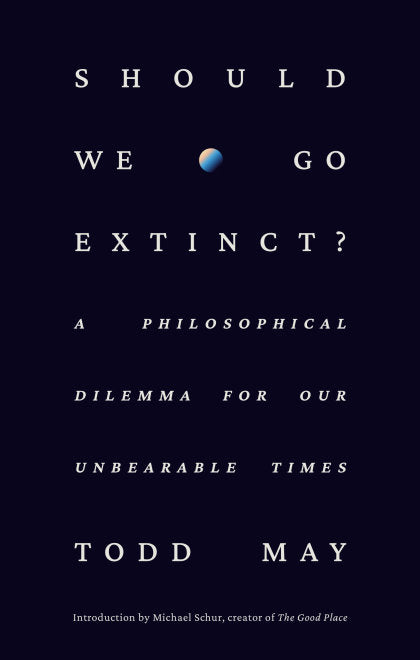
Should We Go Extinct?
Should We Go Extinct?
Couldn't load pickup availability
Collapsible content
ABOUT
“For more than five years, Todd May was my philosophical advisor. I heartily recommend that he be yours as well. (It helps that he’s quite funny.)”—Michael Schur, from the Introduction
These days it’s harder than ever to watch TV, scroll social media, or even just sit at home looking out of the window without contemplating the question at the heart of philosopher Todd May’s Should We Go Extinct? Facing climate destruction and the revived specter of nuclear annihilation even as humans continue to cause untold suffering to our fellow creatures on planet Earth, we are forced each day to contemplate whether the world would be better off in our absence.
In this timely, fascinating examination, May, a renowned philosopher and advisor to the acclaimed TV show The Good Place, reasons both for and against the continuation of our species, trying to help us understand how and whether, the positive and negative tallies of the human ledger are comparable, and what conclusions we might draw about ourselves and our future from doing so. He discusses the value that only humans can bring to the world and to one another as well as the goods, like art and music, that would be lost were we no longer here. On the other side of the ledger, he walks us through the suffering we cause to nature and the non-human world, seeking to understand whether it’s possible to justify such suffering against our merits and if not, what changes we could make to reduce the harm we cause.
In this moment of rising pessimism about the future, and as many people wonder whether they should bring children into such a dark and difficult world, the questions May tackles in Should We Go Extinct? are hardly theoretical. As he explores the complexities involved with changes such as an end to factory farming, curbing scientific testing of animals, reducing the human population, and seeking to develop empathy with our fellow creatures, May sketches a powerful framework for establishing our responsibilities as a species and gives hope that we might one day find universal agreement that the answer to his title question should be No.
STANDARD, PRIMARY, DM AND VARIANT COVERS
Standard and Primary covers are widely available through general retailers. They often have higher print runs and can be cheaper, especially during sales.
In contrast, Direct Market (DM) and variant covers are primarily sold in comic shops. DM editions tend to have more limited availability and may be more valuable to collectors.
The main differences lie in artwork style, availability, price, and collector appeal. Ultimately, the choice between standard and variant covers depends on personal preference, budget, and individual collecting goals.
PRODUCT TYPES
Comic book enthusiasts have various formats to choose from when collecting their favorite stories.
Here's a brief overview of the main types:
Omnibus
- Large, hardcover collections
- Usually contain complete runs or extensive story arcs
- Typically 800-1000+ pages
- Higher price point, often €100-€150
Oversized Hardcover (OHC)
- Similar dimensions to omnibus, but thinner
- Collect shorter runs or story arcs
- Usually 300-600 pages
- Priced between €30-€50
Hardcover (HC)
- Standard-sized hardcover books
- Collect 6-12 issues typically
- Similar dimensions to single issues, but with a hard cover
- Priced around €25-€35
Trade Paperback (TP)
- Softcover collections
- Standard comic book size
- Usually collect 4-6 issues
- Most affordable option, typically €15-€25
Other Formats
- Absolute Editions: Oversized, deluxe hardcovers (mainly DC Comics)
- Compendiums: Massive paperback collections
- Graphic Novels (OGN/GN): Original stories not previously released as single issues
The choice between these formats often depends on personal preference, budget, and collecting goals. Omnibus and OHC editions offer larger artwork and more content but at a higher price, while TPs provide a more affordable way to collect complete story arcs