

Crown
Sing Like Fish
Sing Like Fish
Couldn't load pickup availability
Collapsible content
ABOUT
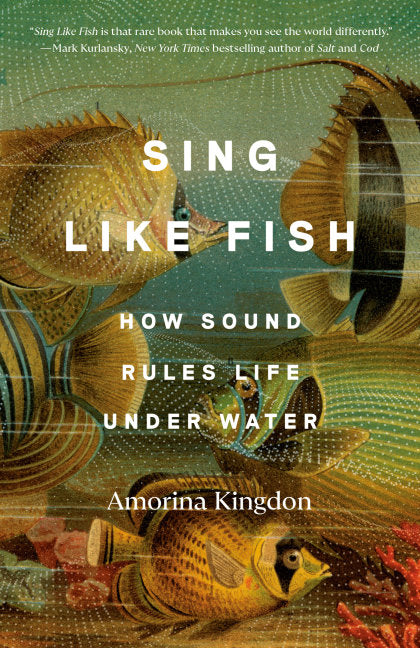
“Sing Like Fish is that rare book that makes you see the world differently.”—Mark Kurlansky, New York Times bestselling author of Salt and Cod
LONGLISTED FOR THE ANDREW CARNEGIE MEDAL FOR EXCELLENCE IN NONFICTION
For centuries, humans ignored sound in the “silent world” of the ocean, assuming that what we couldn’t perceive, didn’t exist. But we couldn’t have been more wrong. Marine scientists now have the technology to record and study the complex interplay of the myriad sounds in the sea. Finally, we can trace how sounds travel with the currents, bounce from the seafloor and surface, bend with the temperature and even saltiness; how sounds help marine life survive; and how human noise can transform entire marine ecosystems.
In Sing Like Fish, award-winning science journalist Amorina Kingdon synthesizes historical discoveries with the latest scientific research in a clear and compelling portrait of this sonic undersea world. From plainfin midshipman fish, whose swim-bladder drumming is loud enough to keep houseboat-dwellers awake, to the syntax of whalesong; from the deafening crackle of snapping shrimp, to the seismic resonance of underwater earthquakes and volcanoes; sound plays a vital role in feeding, mating, parenting, navigating, and warning—even in animals that we never suspected of acoustic ability.
Meanwhile, we jump in our motorboats and cruise ships, oblivious to the impact below us. Our lifestyle is fueled by oil in growling tankers and furnished by goods that travel in massive container ships. Our seas echo with human-made sound, but we are just learning of the repercussions of anthropogenic noise on the marine world’s delicate acoustic ecosystems—masking mating calls, chasing animals from their food, and even wounding creatures, from plankton to lobsters.
With intimate and artful prose, Sing Like Fish tells a uniquely complete story of ocean animals’ submerged sounds, envisions a quieter future, and offers a profound new understanding of the world below the surface.
STANDARD, PRIMARY, DM AND VARIANT COVERS
Standard and Primary covers are widely available through general retailers. They often have higher print runs and can be cheaper, especially during sales.
In contrast, Direct Market (DM) and variant covers are primarily sold in comic shops. DM editions tend to have more limited availability and may be more valuable to collectors.
The main differences lie in artwork style, availability, price, and collector appeal. Ultimately, the choice between standard and variant covers depends on personal preference, budget, and individual collecting goals.
PRODUCT TYPES
Comic book enthusiasts have various formats to choose from when collecting their favorite stories.
Here's a brief overview of the main types:
Omnibus
- Large, hardcover collections
- Usually contain complete runs or extensive story arcs
- Typically 800-1000+ pages
- Higher price point, often €100-€150
Oversized Hardcover (OHC)
- Similar dimensions to omnibus, but thinner
- Collect shorter runs or story arcs
- Usually 300-600 pages
- Priced between €30-€50
Hardcover (HC)
- Standard-sized hardcover books
- Collect 6-12 issues typically
- Similar dimensions to single issues, but with a hard cover
- Priced around €25-€35
Trade Paperback (TP)
- Softcover collections
- Standard comic book size
- Usually collect 4-6 issues
- Most affordable option, typically €15-€25
Other Formats
- Absolute Editions: Oversized, deluxe hardcovers (mainly DC Comics)
- Compendiums: Massive paperback collections
- Graphic Novels (OGN/GN): Original stories not previously released as single issues
The choice between these formats often depends on personal preference, budget, and collecting goals. Omnibus and OHC editions offer larger artwork and more content but at a higher price, while TPs provide a more affordable way to collect complete story arcs