

Crown
Six Sigma
Six Sigma
Couldn't load pickup availability
Collapsible content
ABOUT
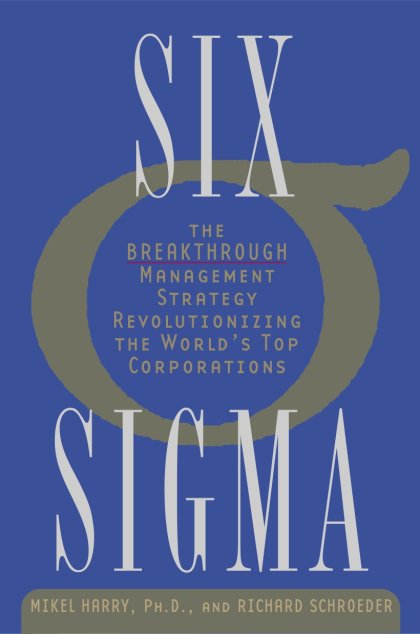
Six Sigma is the most powerful breakthrough management tool ever devised, promising increased market share, cost reductions, and dramatic improvements in bottom-line profitability for companies of any size. The darling of Wall Street, it has become the mantra of Fortune 500 boardrooms around the world because it works.
What is Six Sigma? It is first and foremost a business process that enables companies to increase profits dramatically by streamlining operations, improving quality, and eliminating defects or mistakes in everything a company does, from filling out purchase orders to manufacturing airplane engines. While traditional quality programs have focused on detecting and correcting defects, Six Sigma encompasses something broader: It provides specific methods to re-create the process itself so that defects are never produced in the first place.
Most companies operate at a three- to four-sigma level, where the cost of defects is roughly 20 to 30 percent of revenues. By approaching Six Sigma--fewer than one defect per 3.4 million opportunities--the cost of quality drops to less than 1 percent of sales.
This is because the highest quality also results in the lowest costs. When GE reduced its costs from 20 percent to less than 10 percent, it saved a billion dollars in just two years--money that goes directly to the bottom line. This is the reason Wall Street and corporations as diverse as Sony, Ford, Nokia, Texas Instruments, Canon, Hitachi, Lockheed Martin, American Express, Toshiba, DuPont, and Polaroid have embarked on corporate-wide Six Sigma programs.
Six Sigma should be of paramount importance to every forward-thinking executive and manager determined to make their company world-class in their industry.
STANDARD, PRIMARY, DM AND VARIANT COVERS
Standard and Primary covers are widely available through general retailers. They often have higher print runs and can be cheaper, especially during sales.
In contrast, Direct Market (DM) and variant covers are primarily sold in comic shops. DM editions tend to have more limited availability and may be more valuable to collectors.
The main differences lie in artwork style, availability, price, and collector appeal. Ultimately, the choice between standard and variant covers depends on personal preference, budget, and individual collecting goals.
PRODUCT TYPES
Comic book enthusiasts have various formats to choose from when collecting their favorite stories.
Here's a brief overview of the main types:
Omnibus
- Large, hardcover collections
- Usually contain complete runs or extensive story arcs
- Typically 800-1000+ pages
- Higher price point, often €100-€150
Oversized Hardcover (OHC)
- Similar dimensions to omnibus, but thinner
- Collect shorter runs or story arcs
- Usually 300-600 pages
- Priced between €30-€50
Hardcover (HC)
- Standard-sized hardcover books
- Collect 6-12 issues typically
- Similar dimensions to single issues, but with a hard cover
- Priced around €25-€35
Trade Paperback (TP)
- Softcover collections
- Standard comic book size
- Usually collect 4-6 issues
- Most affordable option, typically €15-€25
Other Formats
- Absolute Editions: Oversized, deluxe hardcovers (mainly DC Comics)
- Compendiums: Massive paperback collections
- Graphic Novels (OGN/GN): Original stories not previously released as single issues
The choice between these formats often depends on personal preference, budget, and collecting goals. Omnibus and OHC editions offer larger artwork and more content but at a higher price, while TPs provide a more affordable way to collect complete story arcs