

Catapult
Spirit Run
Spirit Run
Couldn't load pickup availability
Collapsible content
ABOUT
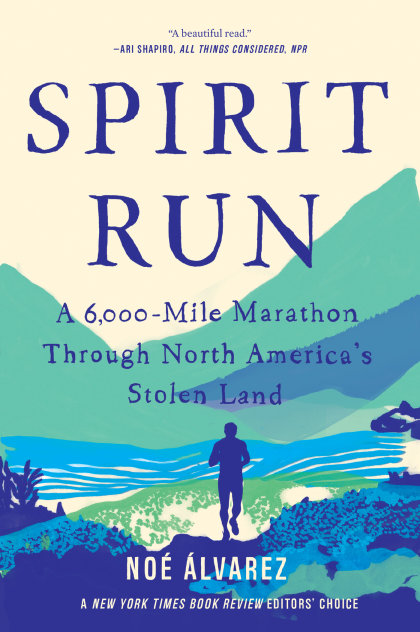
The son of working-class Mexican immigrants flees a life of labor in fruit-packing plants to run in a Native American marathon from Canada to Guatemala in this "stunning memoir that moves to the rhythm of feet, labor, and the many landscapes of the Americas" (Catriona Menzies-Pike, author of The Long Run)
Growing up in Yakima, Washington, Noé Álvarez worked at an apple–packing plant alongside his mother, who “slouched over a conveyor belt of fruit, shoulder to shoulder with mothers conditioned to believe this was all they could do with their lives.” A university scholarship offered escape, but as a first–generation Latino college–goer, Álvarez struggled to fit in.
At nineteen, he learned about a Native American/First Nations movement called the Peace and Dignity Journeys, epic marathons meant to renew cultural connections across North America. He dropped out of school and joined a group of Dené, Secwépemc, Gitxsan, Dakelh, Apache, Tohono O’odham, Seri, Purépecha, and Maya runners, all fleeing difficult beginnings. Telling their stories alongside his own, Álvarez writes about a four–month–long journey from Canada to Guatemala that pushed him to his limits. He writes not only of overcoming hunger, thirst, and fear—dangers included stone–throwing motorists and a mountain lion—but also of asserting Indigenous and working–class humanity in a capitalist society where oil extraction, deforestation, and substance abuse wreck communities.
Running through mountains, deserts, and cities, and through the Mexican territory his parents left behind, Álvarez forges a new relationship with the land, and with the act of running, carrying with him the knowledge of his parents’ migration, and—against all odds in a society that exploits his body and rejects his spirit—the dream of a liberated future.
"This book is not like any other out there. You will see this country in a fresh way, and you might see aspects of your own soul. A beautiful run." —Luís Alberto Urrea, author of The House of Broken Angels
"An anthem to the landscape that holds our identities and traumas, and its profound power to heal them." —Francisco Cantú, author of The Line Becomes a River
STANDARD, PRIMARY, DM AND VARIANT COVERS
Standard and Primary covers are widely available through general retailers. They often have higher print runs and can be cheaper, especially during sales.
In contrast, Direct Market (DM) and variant covers are primarily sold in comic shops. DM editions tend to have more limited availability and may be more valuable to collectors.
The main differences lie in artwork style, availability, price, and collector appeal. Ultimately, the choice between standard and variant covers depends on personal preference, budget, and individual collecting goals.
PRODUCT TYPES
Comic book enthusiasts have various formats to choose from when collecting their favorite stories.
Here's a brief overview of the main types:
Omnibus
- Large, hardcover collections
- Usually contain complete runs or extensive story arcs
- Typically 800-1000+ pages
- Higher price point, often €100-€150
Oversized Hardcover (OHC)
- Similar dimensions to omnibus, but thinner
- Collect shorter runs or story arcs
- Usually 300-600 pages
- Priced between €30-€50
Hardcover (HC)
- Standard-sized hardcover books
- Collect 6-12 issues typically
- Similar dimensions to single issues, but with a hard cover
- Priced around €25-€35
Trade Paperback (TP)
- Softcover collections
- Standard comic book size
- Usually collect 4-6 issues
- Most affordable option, typically €15-€25
Other Formats
- Absolute Editions: Oversized, deluxe hardcovers (mainly DC Comics)
- Compendiums: Massive paperback collections
- Graphic Novels (OGN/GN): Original stories not previously released as single issues
The choice between these formats often depends on personal preference, budget, and collecting goals. Omnibus and OHC editions offer larger artwork and more content but at a higher price, while TPs provide a more affordable way to collect complete story arcs