

Random House Publishing Group
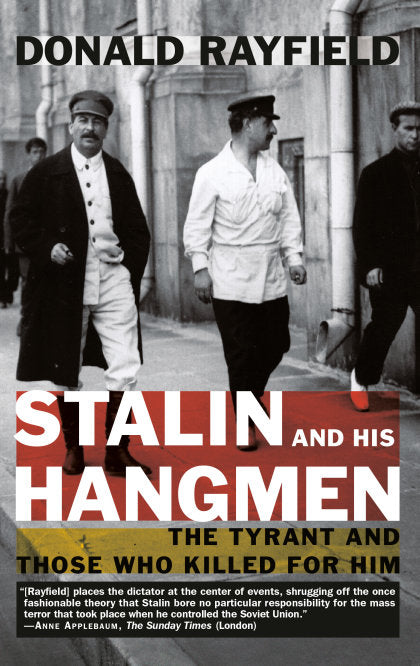
Stalin and His Hangmen
Stalin and His Hangmen
Couldn't load pickup availability
Collapsible content
ABOUT
Founded by Feliks Dzierzynski, the Cheka–the Extraordinary Commission–came to life in the first years of the Russian Revolution. Spreading fear in a time of chaos, the Cheka proved a perfect instrument for Stalin’s ruthless consolidation of power. But brutal as it was, the Cheka under Dzierzynski was amateurish compared to the well-oiled killing machines that succeeded it. Genrikh Iagoda’s OGPU specialized in political assassination, propaganda, and the manipulation of foreign intellectuals. Later, the NKVD recruited a new generation of torturers. Starting in 1938, terror mastermind Lavrenti Beria brought violent repression to a new height of ingenuity and sadism.
As Rayfield shows, Stalin and his henchmen worked relentlessly to coerce and suborn leading Soviet intellectuals, artists, writers, lawyers, and scientists. Maxim Gorky, Aleksandr Fadeev, Alexei Tolstoi, Isaak Babel, and Osip Mandelstam were all caught in Stalin’s web–courted, toyed with, betrayed, and then ruthlessly destroyed. In bringing to light the careers, personalities, relationships, and “accomplishments” of Stalin’s key henchmen and their most prominent victims, Rayfield creates a chilling drama of the intersection of political fanaticism, personal vulnerability, and blind lust for power spanning half a century.
Though Beria lost his power–and his life–after Stalin’s death in 1953, the fundamental methods of the hangmen maintained their grip into the second half of the twentieth century. Indeed, Rayfield argues, the tradition of terror, far from disappearing, has emerged with renewed vitality under Vladimir Putin. Written with grace, passion, and a dazzling command of the intricacies of Soviet politics and society, Stalin and the Hangmen is a devastating indictment of the individuals and ideology that kept Stalin in power.
STANDARD, PRIMARY, DM AND VARIANT COVERS
Standard and Primary covers are widely available through general retailers. They often have higher print runs and can be cheaper, especially during sales.
In contrast, Direct Market (DM) and variant covers are primarily sold in comic shops. DM editions tend to have more limited availability and may be more valuable to collectors.
The main differences lie in artwork style, availability, price, and collector appeal. Ultimately, the choice between standard and variant covers depends on personal preference, budget, and individual collecting goals.
PRODUCT TYPES
Comic book enthusiasts have various formats to choose from when collecting their favorite stories.
Here's a brief overview of the main types:
Omnibus
- Large, hardcover collections
- Usually contain complete runs or extensive story arcs
- Typically 800-1000+ pages
- Higher price point, often €100-€150
Oversized Hardcover (OHC)
- Similar dimensions to omnibus, but thinner
- Collect shorter runs or story arcs
- Usually 300-600 pages
- Priced between €30-€50
Hardcover (HC)
- Standard-sized hardcover books
- Collect 6-12 issues typically
- Similar dimensions to single issues, but with a hard cover
- Priced around €25-€35
Trade Paperback (TP)
- Softcover collections
- Standard comic book size
- Usually collect 4-6 issues
- Most affordable option, typically €15-€25
Other Formats
- Absolute Editions: Oversized, deluxe hardcovers (mainly DC Comics)
- Compendiums: Massive paperback collections
- Graphic Novels (OGN/GN): Original stories not previously released as single issues
The choice between these formats often depends on personal preference, budget, and collecting goals. Omnibus and OHC editions offer larger artwork and more content but at a higher price, while TPs provide a more affordable way to collect complete story arcs