

Penguin Publishing Group
Sultana's Dream and Padmarag
Sultana's Dream and Padmarag
Couldn't load pickup availability
Collapsible content
ABOUT
A Penguin Classics Edition
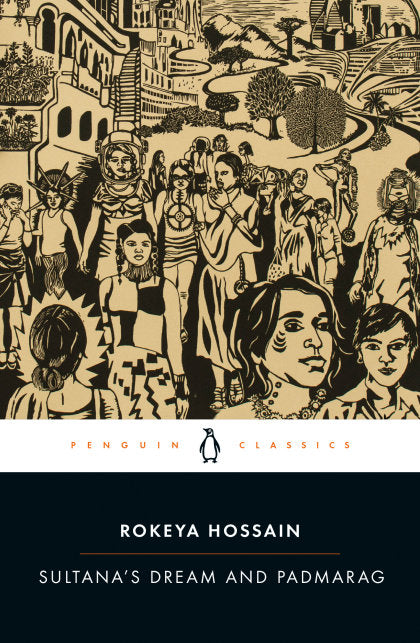
Sultana, a Muslim woman living in colonial India, falls asleep and wakes up in a transformed future world: a utopia in which men rather than women are relegated to the domestic sphere. Women, now free to explore the outside world at will and pursue an education, run a peaceful and just society, using scientific principles to harvest energy from the sun and live in harmony with nature. Sultana’s Dream was published in 1905 in the Indian Ladies Magazine, the first English language periodical edited by, and targeted at, Indian women. Like the periodical, the story broke new ground.
As a pioneering work of science fiction and feminist utopian literature at the turn of the century, Sultana’s Dream is strikingly advanced in its critique of patriarchy, war, industrialization, and the exploitation of the natural world, speaking to the concerns of our contemporary world as much as its own. At a time when British colonialism was using the treatment of women in India as justification for colonial intervention there, Hossain’s story, in imagining a world in which men rather than women are kept inside, positions her protest against Islamic patriarchy within a larger feminist vision that takes on Western as well as Islamic forms of gender hierarchy. Her novella Padmarag is similarly utopian in its depiction of a women-run school and welfare center, and is both feminist and anti-colonial in its outlook. In both these works, Hossain seizes the critique of gender roles in India away from Western commentators and turns it against British interference, while also enlarging the critique to take on the problem of gender more broadly.
STANDARD, PRIMARY, DM AND VARIANT COVERS
Standard and Primary covers are widely available through general retailers. They often have higher print runs and can be cheaper, especially during sales.
In contrast, Direct Market (DM) and variant covers are primarily sold in comic shops. DM editions tend to have more limited availability and may be more valuable to collectors.
The main differences lie in artwork style, availability, price, and collector appeal. Ultimately, the choice between standard and variant covers depends on personal preference, budget, and individual collecting goals.
PRODUCT TYPES
Comic book enthusiasts have various formats to choose from when collecting their favorite stories.
Here's a brief overview of the main types:
Omnibus
- Large, hardcover collections
- Usually contain complete runs or extensive story arcs
- Typically 800-1000+ pages
- Higher price point, often €100-€150
Oversized Hardcover (OHC)
- Similar dimensions to omnibus, but thinner
- Collect shorter runs or story arcs
- Usually 300-600 pages
- Priced between €30-€50
Hardcover (HC)
- Standard-sized hardcover books
- Collect 6-12 issues typically
- Similar dimensions to single issues, but with a hard cover
- Priced around €25-€35
Trade Paperback (TP)
- Softcover collections
- Standard comic book size
- Usually collect 4-6 issues
- Most affordable option, typically €15-€25
Other Formats
- Absolute Editions: Oversized, deluxe hardcovers (mainly DC Comics)
- Compendiums: Massive paperback collections
- Graphic Novels (OGN/GN): Original stories not previously released as single issues
The choice between these formats often depends on personal preference, budget, and collecting goals. Omnibus and OHC editions offer larger artwork and more content but at a higher price, while TPs provide a more affordable way to collect complete story arcs