

Penguin Publishing Group
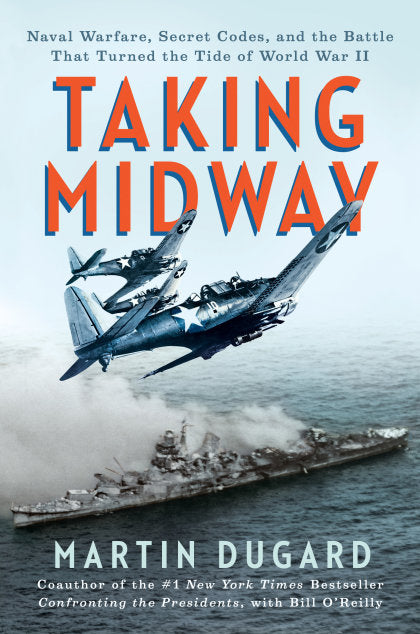
Taking Midway
Taking Midway
Couldn't load pickup availability
Collapsible content
ABOUT
1942. Everywhere around the world, the Allies are losing the war. Nowhere is this felt more completely than in the Pacific, where Japanese sea and ground forces claim victory after victory. Singapore falls. Then the Philippines. The vaunted American Navy fights to a draw with the Japanese at the Battle of Coral Sea. America's lone moral victory is Colonel Jimmy Doolittle's bombing raid on Tokyo—though even that is tinged with tragedy as two crew members are shot down and beheaded.
Meanwhile in Honolulu, a brilliant young naval officer is determined to break Japan's top secret codes. Lieutenant Commander Joseph Rochefort is close to cracking the code by April. He is then startled to learn that the Japanese are planning yet another major invasion somewhere in the Pacific. Admiral Isoroku Yamamoto is planning to send four aircraft carriers to complete this task, in a bold attack that will be even larger than the December 1941 attack on Pearl Harbor.
Rochefort's methods are unique, and those in power in the US Navy find his data flawed. Simply, many don't believe him. The best mind in the US Navy believes the next big attack will come at New Guinea or Australia.
To prove himself, Rochefort must not only find the precise location but predict the date. What ensues is the cat-and-mouse adventure that will become the epic fight known as the Battle of Midway. American and Japanese pilots duel in the skies. Japan's Yamamoto will go toe-to-toe with American admirals Chester Nimitz, Jack Fletcher, and Raymond Spruance. The dramatic battle will involve strategy, luck, heartbreak—and will dramatically alter the course of World War II.
STANDARD, PRIMARY, DM AND VARIANT COVERS
Standard and Primary covers are widely available through general retailers. They often have higher print runs and can be cheaper, especially during sales.
In contrast, Direct Market (DM) and variant covers are primarily sold in comic shops. DM editions tend to have more limited availability and may be more valuable to collectors.
The main differences lie in artwork style, availability, price, and collector appeal. Ultimately, the choice between standard and variant covers depends on personal preference, budget, and individual collecting goals.
PRODUCT TYPES
Comic book enthusiasts have various formats to choose from when collecting their favorite stories.
Here's a brief overview of the main types:
Omnibus
- Large, hardcover collections
- Usually contain complete runs or extensive story arcs
- Typically 800-1000+ pages
- Higher price point, often €100-€150
Oversized Hardcover (OHC)
- Similar dimensions to omnibus, but thinner
- Collect shorter runs or story arcs
- Usually 300-600 pages
- Priced between €30-€50
Hardcover (HC)
- Standard-sized hardcover books
- Collect 6-12 issues typically
- Similar dimensions to single issues, but with a hard cover
- Priced around €25-€35
Trade Paperback (TP)
- Softcover collections
- Standard comic book size
- Usually collect 4-6 issues
- Most affordable option, typically €15-€25
Other Formats
- Absolute Editions: Oversized, deluxe hardcovers (mainly DC Comics)
- Compendiums: Massive paperback collections
- Graphic Novels (OGN/GN): Original stories not previously released as single issues
The choice between these formats often depends on personal preference, budget, and collecting goals. Omnibus and OHC editions offer larger artwork and more content but at a higher price, while TPs provide a more affordable way to collect complete story arcs