

Berrett-Koehler Publishers
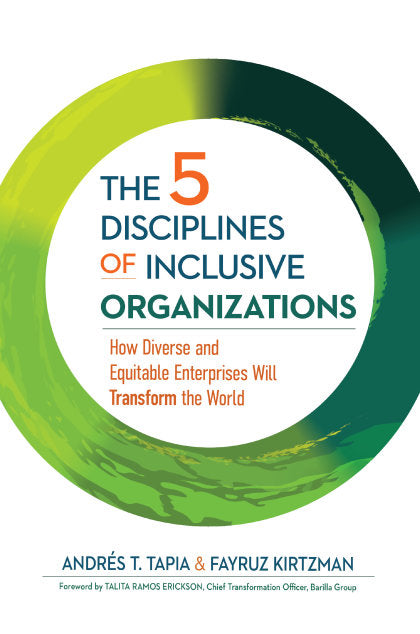
The 5 Disciplines of Inclusive Organizations
The 5 Disciplines of Inclusive Organizations
Couldn't load pickup availability
Collapsible content
ABOUT
Most organizational DE&I efforts are focused on changing individual behaviors. But unless you change the organizational structures—the practices, processes, and systems that surround and support individual behaviors—your change efforts will not take root. Structural inclusion makes behavioral inclusion stick.
Andrés Tapia and Fayruz Kirtzman have found that five disciplines encompass the structures, mindsets, behaviors, and accountabilities required for creating inclusive organizations that will have transformational impact not only on their culture and people but also on society and the planet:
1: Manage the Risk: know how to deal with the legal, reputational, and cultural risks of either doing the wrong thing, or not doing the right thing.
2: Explode the Awareness: make sure leaders and employees are deeply informed about, and publicly committed to, the value of DE&I.
3: Maximize the Talent Systems: ensure that leaders and managers display inclusive behaviors when they manage and optimize talent.
4: Master the Logistics: integrate DE&I into operations in ways that lead to improved efficiencies.
5: See the Marketplace: expand to new consumer market segments, enhance cross culturally competent customer service, and form effective partnerships with overlooked communities.
The authors provide assessment tools and case studies of organizations that have implemented each discipline, highlighting what worked and what tripped them up. And they take a wider view, showing how inclusive organizations practicing the five disciplines can address what they call society’s four vital tasks: diversify leadership, eradicate polarization, achieve justice, and save the planet. This is a complete guide to how to make your organization a systematic, process-oriented engineer of change for the full range of your stakeholders.
STANDARD, PRIMARY, DM AND VARIANT COVERS
Standard and Primary covers are widely available through general retailers. They often have higher print runs and can be cheaper, especially during sales.
In contrast, Direct Market (DM) and variant covers are primarily sold in comic shops. DM editions tend to have more limited availability and may be more valuable to collectors.
The main differences lie in artwork style, availability, price, and collector appeal. Ultimately, the choice between standard and variant covers depends on personal preference, budget, and individual collecting goals.
PRODUCT TYPES
Comic book enthusiasts have various formats to choose from when collecting their favorite stories.
Here's a brief overview of the main types:
Omnibus
- Large, hardcover collections
- Usually contain complete runs or extensive story arcs
- Typically 800-1000+ pages
- Higher price point, often €100-€150
Oversized Hardcover (OHC)
- Similar dimensions to omnibus, but thinner
- Collect shorter runs or story arcs
- Usually 300-600 pages
- Priced between €30-€50
Hardcover (HC)
- Standard-sized hardcover books
- Collect 6-12 issues typically
- Similar dimensions to single issues, but with a hard cover
- Priced around €25-€35
Trade Paperback (TP)
- Softcover collections
- Standard comic book size
- Usually collect 4-6 issues
- Most affordable option, typically €15-€25
Other Formats
- Absolute Editions: Oversized, deluxe hardcovers (mainly DC Comics)
- Compendiums: Massive paperback collections
- Graphic Novels (OGN/GN): Original stories not previously released as single issues
The choice between these formats often depends on personal preference, budget, and collecting goals. Omnibus and OHC editions offer larger artwork and more content but at a higher price, while TPs provide a more affordable way to collect complete story arcs