

Random House Publishing Group
The Age of Miracles
The Age of Miracles
Couldn't load pickup availability
Collapsible content
ABOUT
NAMED ONE OF THE BEST BOOKS OF THE YEAR BY
People ∙ O: The Oprah Magazine ∙ Financial Times ∙ Kansas City Star ∙ BookPage ∙ Kirkus Reviews ∙ Publishers Weekly ∙ Booklist
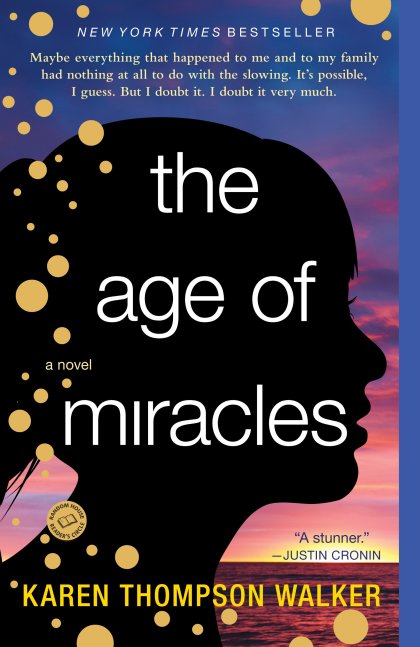
With a voice as distinctive and original as that of The Lovely Bones, and for the fans of the speculative fiction of Margaret Atwood, Karen Thompson Walker’s The Age of Miracles is a luminous and unforgettable debut novel about coming of age set against the backdrop of an utterly altered world.
NEW YORK TIMES BESTSELLER
“Maybe everything that happened to me and to my family had nothing at all to do with the slowing. It's possible, I guess. But I doubt it. I doubt it very much.”
Spellbinding, haunting, The Age of Miracles is a beautiful novel of catastrophe and survival, growth and change, the story of Julia and her family as they struggle to live in an extraordinary time. On an ordinary Saturday, Julia awakes to discover that something has happened to the rotation of the earth. The days and nights are growing longer and longer, gravity is affected, the birds, the tides, human behavior and cosmic rhythms are thrown into disarray. In a world of danger and loss, Julia faces surprising developments in herself, and her personal world—divisions widening between her parents, strange behavior by Hannah and other friends, the vulnerability of first love, a sense of isolation, and a rebellious new strength. With crystalline prose and the indelible magic of a born storyteller, Karen Thompson Walker gives us a breathtaking story of people finding ways to go on, in an ever-evolving world.
Praise for The Age of Miracles
“A stunner.”—Justin Cronin
“A genuinely moving tale that mixes the real and surreal, the ordinary and the extraordinary, with impressive fluency and flair.”—Michiko Kakutani, The New York Times
“Gripping drama . . . flawlessly written; it could be the most assured debut by an American writer since Jennifer Egan’s Emerald City.”—The Denver Post
“If you begin this book, you’ll be loath to set it down until you’ve reached its end.”—San Francisco Chronicle
“Provides solace with its wisdom, compassion, and elegance.”—Curtis Sittenfeld
Don’t miss the exclusive conversation between Karen Thompson Walker and Karen Russell at the back of the book.
STANDARD, PRIMARY, DM AND VARIANT COVERS
Standard and Primary covers are widely available through general retailers. They often have higher print runs and can be cheaper, especially during sales.
In contrast, Direct Market (DM) and variant covers are primarily sold in comic shops. DM editions tend to have more limited availability and may be more valuable to collectors.
The main differences lie in artwork style, availability, price, and collector appeal. Ultimately, the choice between standard and variant covers depends on personal preference, budget, and individual collecting goals.
PRODUCT TYPES
Comic book enthusiasts have various formats to choose from when collecting their favorite stories.
Here's a brief overview of the main types:
Omnibus
- Large, hardcover collections
- Usually contain complete runs or extensive story arcs
- Typically 800-1000+ pages
- Higher price point, often €100-€150
Oversized Hardcover (OHC)
- Similar dimensions to omnibus, but thinner
- Collect shorter runs or story arcs
- Usually 300-600 pages
- Priced between €30-€50
Hardcover (HC)
- Standard-sized hardcover books
- Collect 6-12 issues typically
- Similar dimensions to single issues, but with a hard cover
- Priced around €25-€35
Trade Paperback (TP)
- Softcover collections
- Standard comic book size
- Usually collect 4-6 issues
- Most affordable option, typically €15-€25
Other Formats
- Absolute Editions: Oversized, deluxe hardcovers (mainly DC Comics)
- Compendiums: Massive paperback collections
- Graphic Novels (OGN/GN): Original stories not previously released as single issues
The choice between these formats often depends on personal preference, budget, and collecting goals. Omnibus and OHC editions offer larger artwork and more content but at a higher price, while TPs provide a more affordable way to collect complete story arcs