

DK
The Art of Science
The Art of Science
Couldn't load pickup availability
Collapsible content
ABOUT
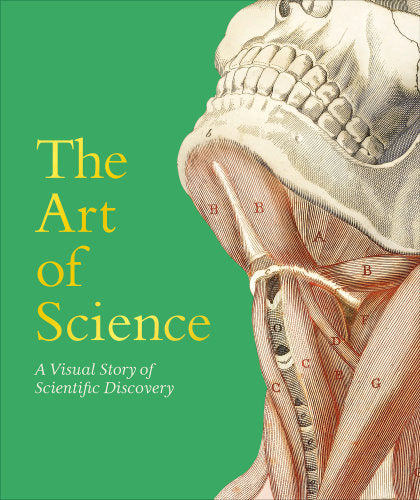
Making images by hand has always been part of science. Throughout history, scientists and artists have created images to capture what they see and communicate their ideas. That tradition is alive and well today.
In this beautiful book, you will find:
- More than 400 drawings, paintings, and other original artworks that span the millennia and human cultures
- Insightful text that sets the images in context, profiles the men and women who made them, and explains how they changed science
- Contemporary artworks and modern scientific images – including photographs, X-rays, and space telescope images – that explain the science and show features that were hidden from the people who made the original images
The Art of Science draws on a wealth of images from all areas of natural history and science, from plants to the human body and Earth science to astronomy and physics. They include images from landmark books such as Leonardo da Vinci’s notebooks, Alexander von Humboldt’s Kosmos, John James Audubon’s Birds of America, and Charles Darwin’s Zoology of the Voyage of HMS Beagle.
Incredible images record historic leaps forward in understanding, such as the first time cells and their nuclei were seen through a microscope or the Moon’s craters were seen through a telescope. Modern artworks and photographic images explain our current understanding of the ideas encapsulated in the artworks, showcasing where scientific understanding has moved on, but also, incredibly, where the people who made the original images were exactly right.
The book opens with an introduction that traces the history of collaboration between artists and scientists and shows how visual communication has moved forward in step with the invention of instruments such as the microscope. It also reveals the transformative effect of the technology for printing and reproduction, from woodblock to the printing press, engraving, and lithography.
A visual history of scientific thought, The Art of Science proves that works of science can also be works of artistry and beauty.
STANDARD, PRIMARY, DM AND VARIANT COVERS
Standard and Primary covers are widely available through general retailers. They often have higher print runs and can be cheaper, especially during sales.
In contrast, Direct Market (DM) and variant covers are primarily sold in comic shops. DM editions tend to have more limited availability and may be more valuable to collectors.
The main differences lie in artwork style, availability, price, and collector appeal. Ultimately, the choice between standard and variant covers depends on personal preference, budget, and individual collecting goals.
PRODUCT TYPES
Comic book enthusiasts have various formats to choose from when collecting their favorite stories.
Here's a brief overview of the main types:
Omnibus
- Large, hardcover collections
- Usually contain complete runs or extensive story arcs
- Typically 800-1000+ pages
- Higher price point, often €100-€150
Oversized Hardcover (OHC)
- Similar dimensions to omnibus, but thinner
- Collect shorter runs or story arcs
- Usually 300-600 pages
- Priced between €30-€50
Hardcover (HC)
- Standard-sized hardcover books
- Collect 6-12 issues typically
- Similar dimensions to single issues, but with a hard cover
- Priced around €25-€35
Trade Paperback (TP)
- Softcover collections
- Standard comic book size
- Usually collect 4-6 issues
- Most affordable option, typically €15-€25
Other Formats
- Absolute Editions: Oversized, deluxe hardcovers (mainly DC Comics)
- Compendiums: Massive paperback collections
- Graphic Novels (OGN/GN): Original stories not previously released as single issues
The choice between these formats often depends on personal preference, budget, and collecting goals. Omnibus and OHC editions offer larger artwork and more content but at a higher price, while TPs provide a more affordable way to collect complete story arcs