

Penguin Publishing Group
The Association of Small Bombs
The Association of Small Bombs
Couldn't load pickup availability
Collapsible content
ABOUT
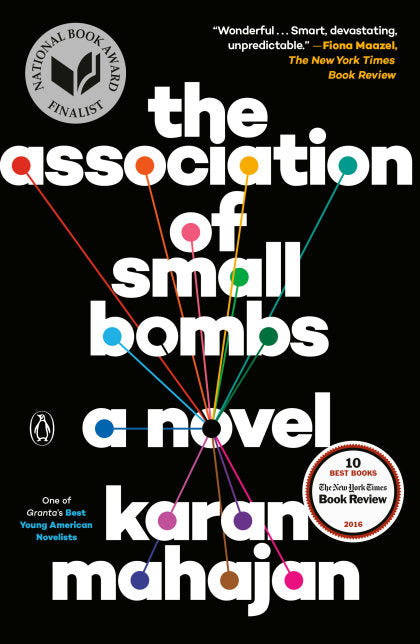
National Book Award Finalist
Winner of the New York Public Library Young Lions Fiction Award
Winner of the American Academy of Arts & Letters Rosenthal Family Foundation Award
Winner of the Anisfield-Wolf Award
Winner of the Bard Fiction Prize
One of the New York Times Book Review’s Ten Best Books of the Year
One of Granta’s Best Young American Novelists
A Washington Post Notable Fiction Book of the Year
PEN Center USA Literary Award Finalist for Fiction
Simpson Family Literary Prize Finalist
Shortlisted for the DSC Prize for South Asian Literature
Longlisted for the FT/Oppenheimer Emerging Voices Award
Named a Best Book of the Year by: Buzzfeed, Esquire, New York magazine, The Huffington Post, The Guardian, The AV Club, The Fader, Redbook, Electric Literature, Book Riot, Bustle, Good magazine, PureWow, and PopSugar
“Wonderful. . . . Smart, devastating, unpredictable. . . . I suggest you go out and buy this one. Post haste.” —Fiona Maazel, The New York Times Book Review
“Brilliant.” —Sam Sacks, The Wall Street Journal
“[Mahajan’s] eagerness to go at the bomb from every angle suggests a voracious approach to fiction-making.” —The New Yorker
One of the most celebrated novels of recent years, The Association of Small Bombs is an expansive and deeply humane novel that is at once groundbreaking in its empathy, dazzling in its acuity, and ambitious in scope
When brothers Tushar and Nakul Khurana, two Delhi schoolboys, pick up their family’s television set at a repair shop with their friend Mansoor Ahmed one day in 1996, disaster strikes without warning. A bomb—one of the many “small” bombs that go off seemingly unheralded across the world—detonates in the Delhi marketplace, instantly claiming the lives of the Khurana boys, to the devastation of their parents. Mansoor survives, bearing the physical and psychological effects of the bomb. After a brief stint at university in America, Mansoor returns to Delhi, where his life becomes entangled with the mysterious and charismatic Ayub, a fearless young activist whose own allegiances and beliefs are more malleable than Mansoor could imagine. Woven among the story of the Khuranas and the Ahmeds is the gripping tale of Shockie, a Kashmiri bomb maker who has forsaken his own life for the independence of his homeland.
Karan Mahajan writes brilliantly about the effects of terrorism on victims and perpetrators, proving himself to be one of the most provocative and dynamic novelists of his generation.
STANDARD, PRIMARY, DM AND VARIANT COVERS
Standard and Primary covers are widely available through general retailers. They often have higher print runs and can be cheaper, especially during sales.
In contrast, Direct Market (DM) and variant covers are primarily sold in comic shops. DM editions tend to have more limited availability and may be more valuable to collectors.
The main differences lie in artwork style, availability, price, and collector appeal. Ultimately, the choice between standard and variant covers depends on personal preference, budget, and individual collecting goals.
PRODUCT TYPES
Comic book enthusiasts have various formats to choose from when collecting their favorite stories.
Here's a brief overview of the main types:
Omnibus
- Large, hardcover collections
- Usually contain complete runs or extensive story arcs
- Typically 800-1000+ pages
- Higher price point, often €100-€150
Oversized Hardcover (OHC)
- Similar dimensions to omnibus, but thinner
- Collect shorter runs or story arcs
- Usually 300-600 pages
- Priced between €30-€50
Hardcover (HC)
- Standard-sized hardcover books
- Collect 6-12 issues typically
- Similar dimensions to single issues, but with a hard cover
- Priced around €25-€35
Trade Paperback (TP)
- Softcover collections
- Standard comic book size
- Usually collect 4-6 issues
- Most affordable option, typically €15-€25
Other Formats
- Absolute Editions: Oversized, deluxe hardcovers (mainly DC Comics)
- Compendiums: Massive paperback collections
- Graphic Novels (OGN/GN): Original stories not previously released as single issues
The choice between these formats often depends on personal preference, budget, and collecting goals. Omnibus and OHC editions offer larger artwork and more content but at a higher price, while TPs provide a more affordable way to collect complete story arcs