

Random House Publishing Group
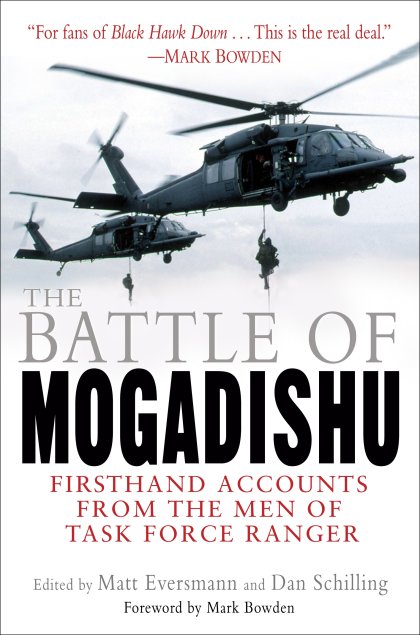
The Battle of Mogadishu
The Battle of Mogadishu
Couldn't load pickup availability
Collapsible content
ABOUT
–MARK BOWDEN (from the Foreword)
It started as a mission to capture a Somali warlord. It turned into a disastrous urban firefight and death-defying rescue operation that shocked the world and rattled a great nation. Now the 1993 battle for Mogadishu, Somalia–the incident that was the basis of the book and film Black Hawk Down–is remembered by the men who fought and survived it. Six of the best in our military recall their brutal experiences and brave contributions in these never-before-published, firstperson accounts.
“Operation Gothic Serpent,” by Matt Eversmann: As a “chalk” leader, Eversmann was part of the first group of Rangers to “fast rope” from the Black Hawk helicopters. It was his chalk that suffered the first casualty of the battle.
“Sua Sponte: Of Their Own Accord,” by Raleigh Cash: Responsible for controlling and directing fire support for the platoon, Cash entered the raging battle in the ground convoy sent to rescue his besieged brothers in arms.
“Through My Eyes,” by Mike Kurth: One of only two African Americans in the battle, Kurth confronted his buddies’ deaths, realizing that “the only people whom I had let get anywhere near me since I was a child were gone.”
“What Was Left Behind,” by John Belman: He roped into the biggest firefight of the battle and considers some of the mistakes that were made, such as using Black Hawk helicopters to provide sniper cover.
“Be Careful What You Wish For,” by Tim Wilkinson: He was one of the Air Force pararescuemen or PJs–the highly trained specialists for whom “That Others May Live” is no catchphrase but a credo–and sums up his incomprehensible courage as “just holding up my end of the deal on a bad day.”
“On Friendship and Firefights,” by Dan Schilling: As a combat controller, he was one of the original planners for the deployment of SOF forces to Mogadishu in the spring of 1993. During the battle, he survived the initial assault and carnage of the vehicle convoys only to return to the city to rescue his two closest friends, becoming, literally, “Last Out.”
With America’s withdrawal from Somalia an oft-cited incitement to Osama bin Laden, it is imperative to revisit this seminal military mission and learn its lessons from the men who were there and, amazingly, are still here.
STANDARD, PRIMARY, DM AND VARIANT COVERS
Standard and Primary covers are widely available through general retailers. They often have higher print runs and can be cheaper, especially during sales.
In contrast, Direct Market (DM) and variant covers are primarily sold in comic shops. DM editions tend to have more limited availability and may be more valuable to collectors.
The main differences lie in artwork style, availability, price, and collector appeal. Ultimately, the choice between standard and variant covers depends on personal preference, budget, and individual collecting goals.
PRODUCT TYPES
Comic book enthusiasts have various formats to choose from when collecting their favorite stories.
Here's a brief overview of the main types:
Omnibus
- Large, hardcover collections
- Usually contain complete runs or extensive story arcs
- Typically 800-1000+ pages
- Higher price point, often €100-€150
Oversized Hardcover (OHC)
- Similar dimensions to omnibus, but thinner
- Collect shorter runs or story arcs
- Usually 300-600 pages
- Priced between €30-€50
Hardcover (HC)
- Standard-sized hardcover books
- Collect 6-12 issues typically
- Similar dimensions to single issues, but with a hard cover
- Priced around €25-€35
Trade Paperback (TP)
- Softcover collections
- Standard comic book size
- Usually collect 4-6 issues
- Most affordable option, typically €15-€25
Other Formats
- Absolute Editions: Oversized, deluxe hardcovers (mainly DC Comics)
- Compendiums: Massive paperback collections
- Graphic Novels (OGN/GN): Original stories not previously released as single issues
The choice between these formats often depends on personal preference, budget, and collecting goals. Omnibus and OHC editions offer larger artwork and more content but at a higher price, while TPs provide a more affordable way to collect complete story arcs