

Penguin Publishing Group
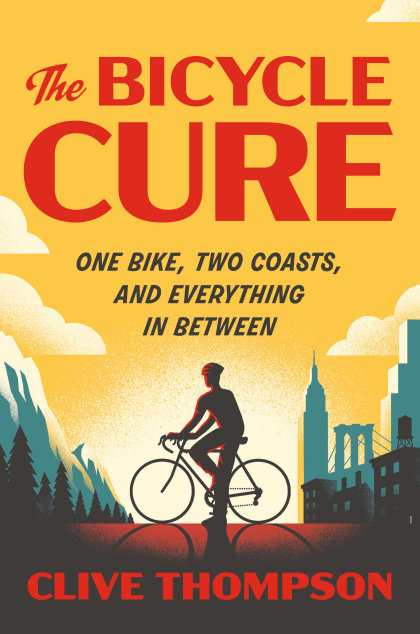
The Bicycle Cure
The Bicycle Cure
Couldn't load pickup availability
Collapsible content
ABOUT
A tech and science writer living in Brooklyn, Clive Thompson grew up as a classic '80s video-game nerd, allergic to sports and macho competition. The one exception? Cycling: He’d always tooled around town on his bike. He liked the low-carbon, environmental vibes, the chill pace of getting from point A to B.
But then, in his fifties, something strange happened: Clive suddenly became an ambitious cyclist. An athlete, even? During COVID he lit out on long jaunts, riding 50 miles, then 100 miles—then 200, 450, more. This weird, mid-life transformation got him curious about himself, and about the country. What exactly were his limits? How much can you upgrade a middle-aged guy? How much can you revamp such an immense country’s approach to mobility? In an age of radical political division, he wanted to know if it’s possible to change direction.
So he hit the road to find out.
Clive came back with a portrait of America that’s gripping, thought-provoking, and frequently hilarious. He got soaked to the bone and nearly marooned in mountain mud; he got chased by ravening packs of farm dogs. But he also discovered a country filled with welcoming, friendly people, crawling with Americans similarly passionate about “micromobility." The roads were alive with fellow cyclists criss-crossing the country: A former duck farmer with a portrait of Jesus on his handlebars, a 32-year-old recovering from depression, a homeless man living in a bike trailer, and a 24-year-old woman crushing 140 miles a day. On some days, America felt like a secret paradise for people on the move.
On others, it felt trapped by the past. From coast to coast, Clive found an American landscape still far too subservient to the automobile—and indifferent, if not hostile, to anyone walking or cycling. Still, even with the backlash to environmentalism, it was clear that change was coming. He saw how ebikes are bringing millions more into the saddle; visited cities that are redesigning their lethal, high-speed streets; and learned how red states like Kansas are hotbeds of clean energy.
Along the way, Clive develops a deep, philosophical connection to his bike, the road, and his body—and a new clarity about the country. He discovers—to his delight—that while he’s not the fastest, and not the strongest, he possesses a mulish level of endurance in the face of pain and adversity. And though he came down from the endorphin buzz, he was left with a rarer and more valuable high these days: hope.
STANDARD, PRIMARY, DM AND VARIANT COVERS
Standard and Primary covers are widely available through general retailers. They often have higher print runs and can be cheaper, especially during sales.
In contrast, Direct Market (DM) and variant covers are primarily sold in comic shops. DM editions tend to have more limited availability and may be more valuable to collectors.
The main differences lie in artwork style, availability, price, and collector appeal. Ultimately, the choice between standard and variant covers depends on personal preference, budget, and individual collecting goals.
PRODUCT TYPES
Comic book enthusiasts have various formats to choose from when collecting their favorite stories.
Here's a brief overview of the main types:
Omnibus
- Large, hardcover collections
- Usually contain complete runs or extensive story arcs
- Typically 800-1000+ pages
- Higher price point, often €100-€150
Oversized Hardcover (OHC)
- Similar dimensions to omnibus, but thinner
- Collect shorter runs or story arcs
- Usually 300-600 pages
- Priced between €30-€50
Hardcover (HC)
- Standard-sized hardcover books
- Collect 6-12 issues typically
- Similar dimensions to single issues, but with a hard cover
- Priced around €25-€35
Trade Paperback (TP)
- Softcover collections
- Standard comic book size
- Usually collect 4-6 issues
- Most affordable option, typically €15-€25
Other Formats
- Absolute Editions: Oversized, deluxe hardcovers (mainly DC Comics)
- Compendiums: Massive paperback collections
- Graphic Novels (OGN/GN): Original stories not previously released as single issues
The choice between these formats often depends on personal preference, budget, and collecting goals. Omnibus and OHC editions offer larger artwork and more content but at a higher price, while TPs provide a more affordable way to collect complete story arcs