

Penguin Publishing Group
The Bird Way
The Bird Way
Couldn't load pickup availability
Collapsible content
ABOUT
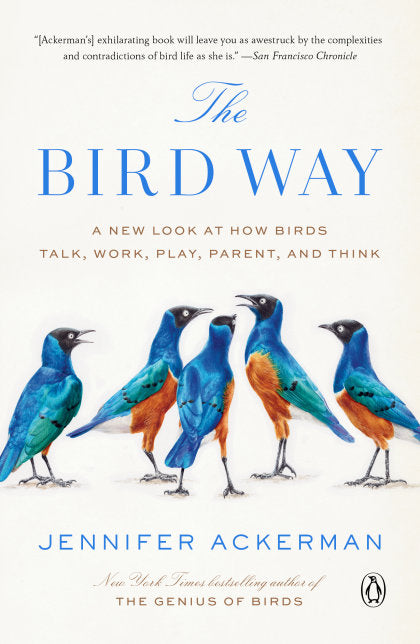
“There is the mammal way and there is the bird way.” But the bird way is much more than a unique pattern of brain wiring, and lately, scientists have taken a new look at bird behaviors they have, for years, dismissed as anomalies or mysteries –– What they are finding is upending the traditional view of how birds conduct their lives, how they communicate, forage, court, breed, survive. They are also revealing the remarkable intelligence underlying these activities, abilities we once considered uniquely our own: deception, manipulation, cheating, kidnapping, infanticide, but also ingenious communication between species, cooperation, collaboration, altruism, culture, and play.
Some of these extraordinary behaviors are biological conundrums that seem to push the edges of, well, birdness: a mother bird that kills her own infant sons, and another that selflessly tends to the young of other birds as if they were her own; a bird that collaborates in an extraordinary way with one species—ours—but parasitizes another in gruesome fashion; birds that give gifts and birds that steal; birds that dance or drum, that paint their creations or paint themselves; birds that build walls of sound to keep out intruders and birds that summon playmates with a special call—and may hold the secret to our own penchant for playfulness and the evolution of laughter.
Drawing on personal observations, the latest science, and her bird-related travel around the world, from the tropical rainforests of eastern Australia and the remote woodlands of northern Japan, to the rolling hills of lower Austria and the islands of Alaska’s Kachemak Bay, Jennifer Ackerman shows there is clearly no single bird way of being. In every respect, in plumage, form, song, flight, lifestyle, niche, and behavior, birds vary. It is what we love about them. As E.O Wilson once said, when you have seen one bird, you have not seen them all.
STANDARD, PRIMARY, DM AND VARIANT COVERS
Standard and Primary covers are widely available through general retailers. They often have higher print runs and can be cheaper, especially during sales.
In contrast, Direct Market (DM) and variant covers are primarily sold in comic shops. DM editions tend to have more limited availability and may be more valuable to collectors.
The main differences lie in artwork style, availability, price, and collector appeal. Ultimately, the choice between standard and variant covers depends on personal preference, budget, and individual collecting goals.
PRODUCT TYPES
Comic book enthusiasts have various formats to choose from when collecting their favorite stories.
Here's a brief overview of the main types:
Omnibus
- Large, hardcover collections
- Usually contain complete runs or extensive story arcs
- Typically 800-1000+ pages
- Higher price point, often €100-€150
Oversized Hardcover (OHC)
- Similar dimensions to omnibus, but thinner
- Collect shorter runs or story arcs
- Usually 300-600 pages
- Priced between €30-€50
Hardcover (HC)
- Standard-sized hardcover books
- Collect 6-12 issues typically
- Similar dimensions to single issues, but with a hard cover
- Priced around €25-€35
Trade Paperback (TP)
- Softcover collections
- Standard comic book size
- Usually collect 4-6 issues
- Most affordable option, typically €15-€25
Other Formats
- Absolute Editions: Oversized, deluxe hardcovers (mainly DC Comics)
- Compendiums: Massive paperback collections
- Graphic Novels (OGN/GN): Original stories not previously released as single issues
The choice between these formats often depends on personal preference, budget, and collecting goals. Omnibus and OHC editions offer larger artwork and more content but at a higher price, while TPs provide a more affordable way to collect complete story arcs