

Penguin Publishing Group
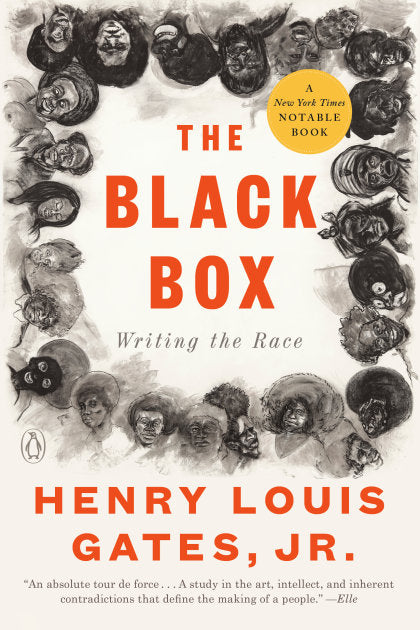
The Black Box
The Black Box
Couldn't load pickup availability
Collapsible content
ABOUT
“Henry Louis Gates is a national treasure. Here, he returns with an intellectual and at times deeply personal meditation on the hard-fought evolution and the very meaning of African American identity, calling upon our country to transcend its manufactured divisions.” — Isabel Wilkerson, author of The Warmth of Other Suns and Caste
“This is a literary history of Black America, but it is also an argument that African American history is inextricable from the history of African American literature.”
—The New York Times
A magnificent, foundational reckoning with how Black Americans have used the written word to define and redefine themselves, in resistance to the lies of racism and often in heated disagreement with one another, over the course of the country’s history
Distilled over many years from Henry Louis Gates, Jr.’s, legendary Harvard introductory course in African American studies, The Black Box: Writing the Race, is the story of Black self-definition in America through the prism of the writers who have led the way. From Phillis Wheatley and Frederick Douglass, W. E. B. Du Bois and Booker T. Washington to Zora Neale Hurston and Richard Wright, James Baldwin and Toni Morrison—these writers used words to create a livable world, a home, for Black people destined to live out their lives in a bitterly racist society.
It is a book grounded in the beautiful irony that a group formed legally and conceptually by its oppressors to justify brutal subhuman bondage transformed itself through the word into a community joined in overcoming one of history’s most pernicious lies. Out of that contested ground has flowered a resilient, creative, powerful, diverse culture of people who have often disagreed markedly about what it means to be Black, and about how best to use the past to create a more just and equitable future.
This is the epic story of how, through essays and speeches, novels, plays, and poems, a long line of creative thinkers has unveiled the contours of—and resisted confinement in—the black box inside which this nation within a nation has been assigned, willy-nilly, from the nation’s founding through to today. This is a book that records the compelling saga of the creation of a people.
STANDARD, PRIMARY, DM AND VARIANT COVERS
Standard and Primary covers are widely available through general retailers. They often have higher print runs and can be cheaper, especially during sales.
In contrast, Direct Market (DM) and variant covers are primarily sold in comic shops. DM editions tend to have more limited availability and may be more valuable to collectors.
The main differences lie in artwork style, availability, price, and collector appeal. Ultimately, the choice between standard and variant covers depends on personal preference, budget, and individual collecting goals.
PRODUCT TYPES
Comic book enthusiasts have various formats to choose from when collecting their favorite stories.
Here's a brief overview of the main types:
Omnibus
- Large, hardcover collections
- Usually contain complete runs or extensive story arcs
- Typically 800-1000+ pages
- Higher price point, often €100-€150
Oversized Hardcover (OHC)
- Similar dimensions to omnibus, but thinner
- Collect shorter runs or story arcs
- Usually 300-600 pages
- Priced between €30-€50
Hardcover (HC)
- Standard-sized hardcover books
- Collect 6-12 issues typically
- Similar dimensions to single issues, but with a hard cover
- Priced around €25-€35
Trade Paperback (TP)
- Softcover collections
- Standard comic book size
- Usually collect 4-6 issues
- Most affordable option, typically €15-€25
Other Formats
- Absolute Editions: Oversized, deluxe hardcovers (mainly DC Comics)
- Compendiums: Massive paperback collections
- Graphic Novels (OGN/GN): Original stories not previously released as single issues
The choice between these formats often depends on personal preference, budget, and collecting goals. Omnibus and OHC editions offer larger artwork and more content but at a higher price, while TPs provide a more affordable way to collect complete story arcs