

Candlewick Press
The Blue Jays That Grew a Forest
The Blue Jays That Grew a Forest
Couldn't load pickup availability
Collapsible content
ABOUT
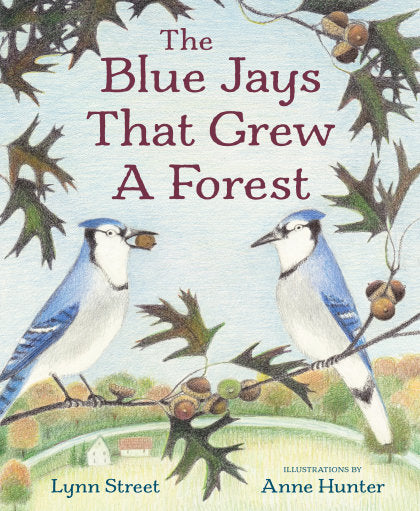
Most of us know about the mighty oak tree, and how important oaks are as a keystone species. But we may be less aware of the role that blue jays play in assisting the expansion of oak tree forests.
Covering one full year from season to season, we learn about the habits of the blue jays. All summer long they feed on bugs, berries, and seeds. But as autumn approaches, they perch in the canopy waiting for the acorns to ripen. With cold weather coming soon, this blue crew hauls away acorns, each bird taking as many as five per load. They fly over a farm or two and hide the acorns in a sunny open area where they can find them later when other food is scarce. But not all acorns will be eaten. Little do the jays know that the treasures they bury may one day become the beginnings of a new oak forest.
This debut picture book from poet Lynn Street lyrically celebrates the connection between blue jays and oak trees. It will appeal to readers fascinated by the behavior of birds and by the reciprocal relationships found in nature. While jays depend on acorns for food, the oak depends on jays to scatter its fruit far and wide. Blue jays have specially developed pouches in their throats that allow them to carry several acorns at a time, and they can travel as far as 1,500 miles in a season burying their acorns. A keystone species in oak forest ecosystems, these familiar birds are thought to have contributed to reestablishing oak forests after the last ice age. The detailed back matter provides further information about oaks and jays.
Geisel Honoree artist Anne Hunter, who lives in the jay-filled woods of Vermont, illustrated this book with great affection for these beautiful, clever, and sometimes noisy birds. After reading this book, you will see blue jays in an entirely new light.
Eureka! Nonfiction Children's Book Silver Award
STANDARD, PRIMARY, DM AND VARIANT COVERS
Standard and Primary covers are widely available through general retailers. They often have higher print runs and can be cheaper, especially during sales.
In contrast, Direct Market (DM) and variant covers are primarily sold in comic shops. DM editions tend to have more limited availability and may be more valuable to collectors.
The main differences lie in artwork style, availability, price, and collector appeal. Ultimately, the choice between standard and variant covers depends on personal preference, budget, and individual collecting goals.
PRODUCT TYPES
Comic book enthusiasts have various formats to choose from when collecting their favorite stories.
Here's a brief overview of the main types:
Omnibus
- Large, hardcover collections
- Usually contain complete runs or extensive story arcs
- Typically 800-1000+ pages
- Higher price point, often €100-€150
Oversized Hardcover (OHC)
- Similar dimensions to omnibus, but thinner
- Collect shorter runs or story arcs
- Usually 300-600 pages
- Priced between €30-€50
Hardcover (HC)
- Standard-sized hardcover books
- Collect 6-12 issues typically
- Similar dimensions to single issues, but with a hard cover
- Priced around €25-€35
Trade Paperback (TP)
- Softcover collections
- Standard comic book size
- Usually collect 4-6 issues
- Most affordable option, typically €15-€25
Other Formats
- Absolute Editions: Oversized, deluxe hardcovers (mainly DC Comics)
- Compendiums: Massive paperback collections
- Graphic Novels (OGN/GN): Original stories not previously released as single issues
The choice between these formats often depends on personal preference, budget, and collecting goals. Omnibus and OHC editions offer larger artwork and more content but at a higher price, while TPs provide a more affordable way to collect complete story arcs